
How Can Carers and Kids Learn to Talk About Gender Identity? | Victoria Range-Carr
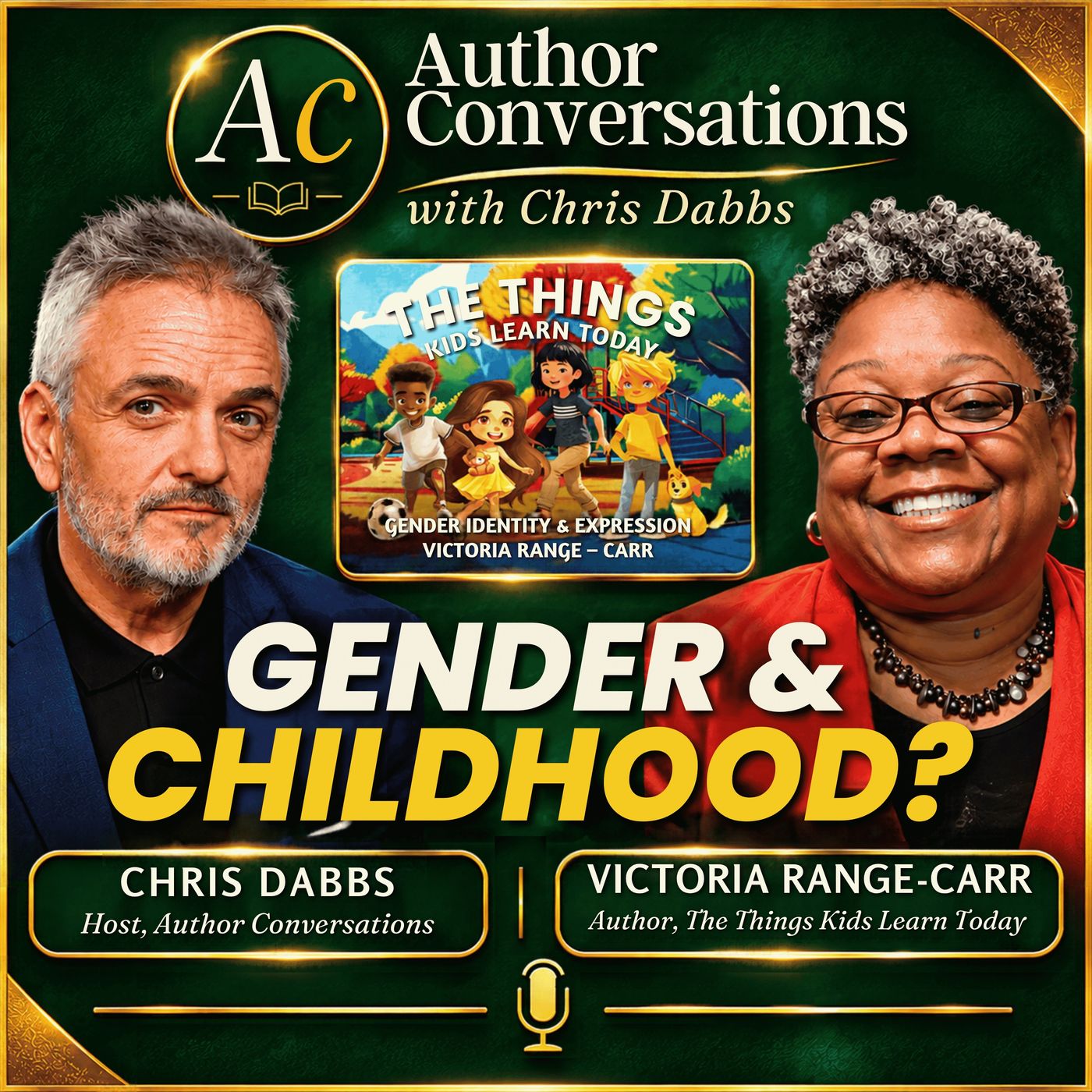
How can carers and children learn to talk about gender identity when the adults themselves may still be trying to understand it?
After more than 20 years working in social services, Victoria Range-Carr has seen what can happen when families struggle to have these conversations. Some of the experiences she shares are particularly difficult, including occasions when adults felt unable to accept a child's identity or self-expression.
In this episode of Author Conversations with me, Chris Dabbs, Victoria talks about the experiences that led her to write The Things Kids Learn Today: Gender Identity & Expression, an illustrated book designed to help children and adults start talking to one another.
We also explore Victoria's own experiences, the influence of faith and family, the importance of listening without judgement and why these conversations extend well beyond parents to foster carers, kinship families, teachers, coaches and other trusted adults.

 iHeartRadio

 Apple Podcasts

 Spotify

 Amazon Music

 Deezer

 Podchaser

 Spreaker

 Castbox

 YouTube
Key Takeaways
- Victoria Range-Carr's book "The Things Kids Learn Today: Gender Identity & Expression" is designed to help children and adults start thoughtful conversations about gender without relying on rigid expectations.
- Children often begin expressing non-traditional gender identities or preferences at a very early age, long before they reach high school or join peer groups.
- Adult caregivers, including parents, foster parents, teachers, and coaches, do not need to have all the answers; rather, they need to provide a safe, non-judgmental space for kids to be heard.
- The colorful illustrations and interactive characters in the book serve to disarm adult biases and foster curiosity around a topic that many find challenging or controversial.
- Faith communities and older generations can benefit greatly from bridging communication gaps to better understand modern terminology and the lived experiences of youth.
How can parents, carers, coaches, teachers, kinship families, other family members and friends talk to children about gender identity and expression, and what role can books play in opening up those conversations?
Victoria Range-Carr is the author of The Things Kids Learn Today: Gender Identity & Expression, a children's book tackling a subject that is increasingly part of wider discussions about childhood, education and understanding.
In this episode of Author Conversations with me, Chris Dabbs, Victoria joins me to talk about her book, the questions it raises and the challenge of explaining complex ideas to younger readers.
We consider the role children's books can play in encouraging discussion, both at home and beyond. Whatever your perspective, it's a subject that deserves a thoughtful conversation.
WATCH THE VIDEO INTERVIEW
https://youtu.be/I_Y4ILJY194
VICTORIA'S EPISODE PAGE
https://www.author-conversatio...
VIctoria's main page:
https://unboxedvoices.com/
ABOUT AUTHOR CONVERSATIONS
Every book has a story beyond its pages.
Author Conversations with Chris Dabbs is an independent interview programme presented by British broadcast journalist, presenter and newsreader Chris Dabbs. With more than two decades of experience in radio, television and digital interviewing, Chris speaks with established and emerging authors, exploring the people, experiences and ideas behind their books.
Official website: https://www.author-conversatio...
Verify official communications: https://www.author-conversatio...
Become a supporter of this podcast: https://www.spreaker.com/podcast/author-conversations-with-chris-dabbs--6905413/support.
These are thoughtful, in-depth interviews that give authors the time and space to talk about their work, their lives and what they hope readers will take away.
Discover Author Conversations with Chris Dabbs:
Official website:
https://www.author-conversations.com/
Watch the interviews:
https://www.youtube.com/@AuthorConversations
Authenticity and verification
To verify genuine interview invitations, correspondence or requests made on behalf of Author Conversations, visit:
https://www.author-conversations.com/verify
Frequently Asked Questions
What is the book "The Things Kids Learn Today: Gender Identity & Expression" about?
It is an illustrated children's book written by Victoria Range-Carr designed to be read together by children and adults to open up conversations about gender identity, expression, and acceptance.
How can parents talk to kids about gender identity when they don't know the terminology?
Range-Carr emphasizes that adults do not need to have a complete set of answers or lived experience; instead, they should focus on listening honestly, validating feelings, and avoiding harsh judgment.
At what age do children typically start expressing non-binary or gender-nonconforming traits?
Professional experience and research indicate that children can express non-traditional gender identities and personal preferences as early as ages three to five.
Why does the book use illustrated characters instead of just definitions?
The characters and colorful illustrations help disarm adult biases and invite curiosity, giving both kids and carers relatable scenarios to help articulate their feelings and start dialogues.
1
00:00:00,000 --> 00:00:15,120
[Music]
2
00:00:15,120 --> 00:00:27,300
Hi and welcome to Author Conversations with me, Chris Dabbs, as usual. It's lovely to have you here and today we've got some quite thoughtful things to go through, I think.
3
00:00:27,300 --> 00:00:35,120
Things that include, well, when children come home with all sorts of questions, you know, some of these are quite easy to answer aren't they?
4
00:00:35,120 --> 00:00:44,800
You know, 2 plus 2 equals 4. Others can either leave even the most experienced parent or carer wondering where to begin with any kind of answer.
5
00:00:44,800 --> 00:00:53,800
And when the questions are about gender, identity, or how we express ourselves, the conversation can feel really difficult.
6
00:00:53,800 --> 00:01:01,800
Sometimes it's simply because the adults are still trying to understand the subject themselves. I know I do this a lot.
7
00:01:01,800 --> 00:01:13,300
My guest today is Victoria Range-Carr. She spent more than 20 years working in social services and is the author of "The Things Kids Learn Today", gender identity and expression.
8
00:01:13,300 --> 00:01:24,300
It's an illustrated book intended to be read together by children and the adults who care for them, which is kind of nice to share the whole idea and the whole questioning point of the book.
9
00:01:24,300 --> 00:01:33,300
And the idea behind the book is not simply to give people terminology that they can use, but it's actually to help them talk to one another about the subjects.
10
00:01:33,300 --> 00:01:39,300
So, on that note, Victoria, welcome to author conversations. It's great to have you here. How are you?
11
00:01:39,300 --> 00:01:44,300
Thank you, Chris. I'm excited to be here. Thank you so much for having me today.
12
00:01:44,300 --> 00:01:54,300
No, not at all. Don't worry. This is a great subject to be talking about, I think, and your book looks lovely, by the way, with illustrations and everything.
13
00:01:54,300 --> 00:02:06,300
And I think it's really timely to be having this kind of book out in the world, as it were. But because, I think, really, your book isn't really saying to parents, "Here are all the answers."
14
00:02:06,300 --> 00:02:12,300
It seems to be saying something like, "Here's a way of starting the conversation."
15
00:02:12,300 --> 00:02:21,300
I mean, is that the problem that you were trying to solve? What were you seeing or hearing that made you think adults needed help with these kinds of conversations with their kids?
16
00:02:21,300 --> 00:02:29,300
That's a really good question. Thank you so much for asking. When I wrote this book, I was working in child welfare.
17
00:02:29,300 --> 00:02:41,300
I was working with families of races and cultures and economies. And when it came to gender identity and expression, they seemed to struggle the most.
18
00:02:41,300 --> 00:02:50,300
There was nothing like having a receptionist call me and say, "Victoria, we've got a family coming in here, and we need you to talk to them."
19
00:02:50,300 --> 00:02:58,300
And on the other side of that was a family who was handing over a child to me saying, "Here, I don't know what to do with them. You take them."
20
00:02:58,300 --> 00:03:10,300
They came home and said, "She said, she likes girls." Or, "He said, he wants to wear women's clothing." For me, that was so overwhelming.
21
00:03:10,300 --> 00:03:24,300
And coupled with other life experiences, it really pushed me to say, "Something more needs to be done on a more global level. I could help in my community with those families."
22
00:03:24,300 --> 00:03:27,300
But there are so many other families just like them.
23
00:03:27,300 --> 00:03:36,300
That's amazing to hear that. Because people just really don't know what to do when those sorts of things happen, I think.
24
00:03:36,300 --> 00:03:46,300
Yeah, that hasn't happened in my family so much. But if it did, yeah, I wouldn't know what to do.
25
00:03:46,300 --> 00:03:53,300
That person, or those people that brought their child in and said, "Here, you have them sorted out. I can't do this."
26
00:03:53,300 --> 00:03:56,300
That must have been heartbreaking for them.
27
00:03:56,300 --> 00:04:08,300
Absolutely. Teams who identify as non-traditional or LGBTQI, they experience so much criticism, so much rejection.
28
00:04:08,300 --> 00:04:16,300
And it often leads to higher rates of mental health disorders or suicidal ideations.
29
00:04:16,300 --> 00:04:27,300
All what I would like to think is unnecessarily. Because what we're all seeking really Chris is acceptance. Right? We want to be seen. We want to be heard.
30
00:04:27,300 --> 00:04:32,300
And we want people to make room for us, especially the ones who say they love us.
31
00:04:32,300 --> 00:04:44,300
So this book is designed with the intention to bridge that desire and the ability that we have as adults so that that thing can happen.
32
00:04:44,300 --> 00:04:49,300
Not just for our youth, but for us as adults because then we all start out as children.
33
00:04:49,300 --> 00:04:52,300
Yeah, we did. That's the point, isn't it?
34
00:04:52,300 --> 00:05:01,300
And we've always asked questions throughout history, haven't we? It's always been why we hear, why do we exist? Why? Why? Why?
35
00:05:01,300 --> 00:05:07,300
There's lots of whys. But I think this is the thing that's changed, I think, in the last, I don't know, however many years.
36
00:05:07,300 --> 00:05:19,300
You spent 20 years in social services. I mean, yeah, what have you seen the change that's happened recently? I mean, what's that taught you about the way that children now ask difficult questions?
37
00:05:19,300 --> 00:05:27,300
Well, I'll tell you this. The things that children are saying about gender identity and expression for people my age.
38
00:05:27,300 --> 00:05:37,300
And I'll just speak to the color of my hair to just, you know, acknowledge my age. But for people my age and older, we didn't have the terminology that they use.
39
00:05:37,300 --> 00:05:49,300
Pronouns were just he, she and they will now there's a they and a Zim and a Zair and all kinds of references to non traditional non binary identifying persons.
40
00:05:49,300 --> 00:06:04,300
So we didn't get to have those conversations certain things, gender identity and expression. I didn't get that conversation with my parents. They, they don't, I don't think they like to have that conversation with me now.
41
00:06:04,300 --> 00:06:18,300
So one of the things and I'll share this on a personal level, I grew up, I still identify as heterosexual, but Chris, I'm in a same sex marriage.
42
00:06:18,300 --> 00:06:27,300
When I said this to my ministering parents, initially their response was, oh my word, what is going to happen to your soul?
43
00:06:27,300 --> 00:06:43,300
That's that mom, please understand God is still God. The almighty God who created the whole world and everything in it. That doesn't change because I'm partnering with the female.
44
00:06:43,300 --> 00:07:04,300
That conversation happens more today, I think than ever before in life because there are so many words to identify if you're familiar with LGBTQI or LGBTQ, you might not be familiar with LGBTQI or an LGBTQIA plus.
45
00:07:04,300 --> 00:07:19,300
Well, what are all of those letters? So this book I'm hoping will inform and educate and bridge communication that once did not even exist, let alone have permission to occur.
46
00:07:19,300 --> 00:07:39,300
I like the way that you put that because you say, obviously heterosexual, you're in a same sex marriage, and then it's all about the kind of judgment of not only parents, but everybody else, but also now you're bringing faith into it as well.
47
00:07:39,300 --> 00:07:55,300
Things get really tricky with that. I've seen that around an awful lot, but it's interesting that you say that these questions are coming up more because we've got the language, or rather we don't, let me look at me, how old am I?
48
00:07:55,300 --> 00:08:10,300
You think you're old, no, but I don't really necessarily have that language, but through my training and things like that, I have picked up enough to hopefully get by without obsessing too many people really because we don't want to upset people, do we?
49
00:08:10,300 --> 00:08:12,300
This is the whole point.
50
00:08:12,300 --> 00:08:22,300
I just think that it's interesting that you say that because what we're really saying there then is that this isn't new, this is not a new phenomenon, right?
51
00:08:22,300 --> 00:08:36,300
It's always been around, but it's always being pushed in the corner or people have been in, I don't know, entertainment maybe, you know, being film stars or whatever. I mean, do you think that's right?
52
00:08:36,300 --> 00:08:58,300
There is some truth to that. I think that because it's been rejected so much on a personal level in smaller areas, when pioneers in this community fought back and said we won't be stifled, we won't be shut down.
53
00:08:58,300 --> 00:09:22,300
I think that's one of the things that I learned from my experience with my partner, is that I'm a person who has a lot of experience, and I'm a person who's a person who has a lot of experience, and I think that's what I learned from my partner.
54
00:09:22,300 --> 00:09:31,300
And otherwise, open doors to language that I would not otherwise have. I grew up in the church. We were definitely not having this conversation.
55
00:09:31,300 --> 00:09:45,300
And so for many Americans, I know religion is a big part of our identity, even though we're the melting pot. There's lots of different people with different religious backgrounds.
56
00:09:45,300 --> 00:09:58,300
There's the faith community, I think, is so afraid to embrace diversity that it has stifled communication in this area.
57
00:09:58,300 --> 00:10:09,300
But as the pioneers pushed and said, we won't be stifled. We are not going anywhere. We have been here from the start of time to today.
58
00:10:09,300 --> 00:10:15,300
We're going to build language that we can share with others. And so our kids are picking up on that.
59
00:10:15,300 --> 00:10:25,300
The internet facilitates that, right? We're no longer in a box locked into our communities through the internet. We have exposure to all kinds of things.
60
00:10:25,300 --> 00:10:37,300
So our kids who can use this technology, right? But the older generations don't use it in the same manner or, as extensively, don't get the exposure that our kids do.
61
00:10:37,300 --> 00:10:46,300
So our kids can very much have language that we don't have because they're exposed to so many things that we just didn't have access to.
62
00:10:46,300 --> 00:11:02,300
So I'm hoping through the book that we create an opportunity in the back of the book. There's a list of resources, books, communities and organizations, as well as TV shows, like there's references where people can find more information about it.
63
00:11:02,300 --> 00:11:12,300
There's this learning curve, I think, for us older people. And so I'm hoping to just bridge that across generations and faith, Chris.
64
00:11:12,300 --> 00:11:20,300
I like that. And I think, I just say faith and the generations, the super important young, old, whatever in the middle.
65
00:11:20,300 --> 00:11:34,300
I was talking to an author the other week about he's an older gay man who was, you know, like we live through AIDS, you know, and all of that stuff going on in the 80s, 70s and everything else.
66
00:11:34,300 --> 00:11:50,300
And he was saying that pretty much the same thing. You know, the message is really important to get out there. And, you know, from their point of view, his particular group, I guess, they're trying to get to make sure that younger people understand what's been going on.
67
00:11:50,300 --> 00:12:04,300
So they're working the other way, if you see what I mean. Whereas I think perhaps younger generations taking off a granted. So, you know, there's like, oh, you know, fine. Yeah, great. We're with this, with whatever it is.
68
00:12:04,300 --> 00:12:12,300
But as we've said in history, people had to fight for this. You know, and people really had to do all this, didn't they?
69
00:12:12,300 --> 00:12:22,300
And I think that that's, well, that's not only to do with gender or sexuality, but, you know, it can be all sorts of different things. It's got a race or religion or anything. Right.
70
00:12:22,300 --> 00:12:35,300
So, I mean, when the children do ask these questions, I think looking for like a really detailed explanation. Or do they just want, you know, I don't know, an adult to listen and answer honestly.
71
00:12:35,300 --> 00:12:43,300
Or I think expecting an argument. I mean, what do you actually think? What if you're seeing you in your career?
72
00:12:43,300 --> 00:12:58,300
Yeah, that's a good question. I think what they're looking for most is, again, room to be who they are and a listening ear because it's not common practice.
73
00:12:58,300 --> 00:13:25,300
It's still somewhat nuanced. It doesn't fit in the group of peers because it's so quiet. If you're growing up in a close community and you recognize that you're different from others, where do you find safety to express yourself to get questions answered about how you feel or why you feel the way you feel.
74
00:13:25,300 --> 00:13:43,300
And I think that that's what they're looking for. So it doesn't matter if it's a parent or a teacher or a case worker or a youth minister as adults providing information to children and shaping their lives.
75
00:13:43,300 --> 00:14:05,300
Part of our responsibility is being that listening ear. If we think about when we were younger, how we want others to engage us, how we wanted others to validate our ideas, whether it was a good idea for a project or a good idea for dinner or a good idea for how we dressed.
76
00:14:05,300 --> 00:14:21,300
We want our parents to look at us and say, oh, that's different, but I'm okay with that. They didn't have to agree. I think I'm going to wear it. You see videos today where kids are trying to dress up and then the parents put on the clothes so the kids can see what it looks like.
77
00:14:21,300 --> 00:14:25,300
That's one way to communicate. You haven't seen that. They've got something.
78
00:14:25,300 --> 00:14:37,300
So a young girl might be wearing a very short, short skirt in a little tootop and her dad is in the video when he comes out and and hills and many skirt and a tootop. She's like, no, dad, no.
79
00:14:37,300 --> 00:14:41,300
There's many ways.
80
00:14:41,300 --> 00:14:45,300
I wouldn't do that.
81
00:14:45,300 --> 00:14:55,300
But there's many ways to show a kid. I hear you and I see you in years what I see. Right.
82
00:14:55,300 --> 00:15:05,300
In those videos, it's not judging. In fact, he doesn't say anything at all. He just demonstrates what it looks like.
83
00:15:05,300 --> 00:15:20,300
It opens a conversation. The youth is the one that actually says, what are you doing? Right. I think what youth want most is the opportunity to talk about where they are and what they're going through.
84
00:15:20,300 --> 00:15:32,300
And this is the same for all of us across generations. They want to understand what's going on in their hearts and their minds and their bodies. And they want to feel safe when they do that.
85
00:15:32,300 --> 00:15:47,300
In my youth, perhaps, what happened, and afterwards, obviously, I'm that old. People probably ran away from home to try and find others because they didn't have the internet. They didn't have the capabilities of being able to talk to other people.
86
00:15:47,300 --> 00:16:00,300
And I think maybe this is something to do with, they want respect, as you said, they really want to be respected rather than have respect. So in other words, they're opinions valid.
87
00:16:00,300 --> 00:16:08,300
I think that makes sense. And I think personally, and I'd be interested to know what you think about this, Victoria.
88
00:16:08,300 --> 00:16:24,300
When I was growing up, it was all about being part of a group, a group of people. And I'm sure we see it all the time with American high schools. You've got all various different groups of people that people join.
89
00:16:24,300 --> 00:16:32,300
And not one group talks to another group and all of that sort of thing. But I'm talking more about fashion and things like that.
90
00:16:32,300 --> 00:16:43,300
Or if you're a fan of a particular music group or a fan of a particular genre, well, not something. Well, yeah, I guess it was genres back then, but it's more like groups rather than genres or singers.
91
00:16:43,300 --> 00:16:58,300
I mean, do you think that that is something that's that's kind of similar. So in other words, what I'm trying to say is, if someone is coming home to wherever and they're trying to talk to an adult, and they're saying, you know, this is what I want to do. This is what I want to do.
92
00:16:58,300 --> 00:17:11,300
It's not their best option to talk to their adult carer about this is it because they're obviously would rather talk to people who kind of know what they're talking about already.
93
00:17:11,300 --> 00:17:26,300
Now, this is around about way of saying, we can only do as much as we can, isn't it? Really? At the end of the day, we're talking about something that we can only try and understand from a, I guess, a caring point of view.
94
00:17:26,300 --> 00:17:30,300
Not actually a lived experience point of view. Does that make it any sense to you?
95
00:17:30,300 --> 00:17:48,300
I don't think that that matters though. And let me tell you why. In my education and my professional experience, it is believed that people who identify as non-binary, do so at a very early age.
96
00:17:48,300 --> 00:18:08,300
As young as three, express of at five. In my personal life, I have a cousin who identifies as bisexual. And she has more masculine traits or tendencies, if you will.
97
00:18:08,300 --> 00:18:27,300
Her mother said to me in a conversation once, I knew she was different as a toddler. Right? So at that age, we don't have groups or clicks or people like us. We have family.
98
00:18:27,300 --> 00:18:43,300
We have our parents. We have our siblings. We have our grandparents. So we can't necessarily afford to wait until we're high school or junior high to allow a child to be safe in their communication or their self expression.
99
00:18:43,300 --> 00:18:55,300
We start this early on and we do so best when we don't project our ideas about children. We have children who say, oh, in my son grows up, he's going to be a baseball player.
100
00:18:55,300 --> 00:19:09,300
I put up a glove in his hand as soon as he can hold it. We're taking pictures of babies and baseball gloves. What if they don't like baseball? What if they have an affinity for race cars?
101
00:19:09,300 --> 00:19:26,300
It's the same. What if a child is born and they look female on the inside? But they have a tendency to be more masculine and their expression.
102
00:19:26,300 --> 00:19:45,300
Is there really anything wrong with that? Because the message we teach to girls today is be strong. Right? So why then when we're strong? Is it criticized or questioned or challenged as if it's not a natural place for a female born to be?
103
00:19:45,300 --> 00:19:55,300
It's this kind of confusing messaging that we give when we don't make room for our children right where they are as early as we see it.
104
00:19:55,300 --> 00:20:07,300
Amazing. Thank you for that. I think that's a point that I personally have missed. If you're talking about it, those conversations can start that early.
105
00:20:07,300 --> 00:20:20,300
Absolutely. We need to look at this. Is that one of the ways that you use the idea of four children in the book? Johnny, is it Mary or Mary? Don and Ella, I think it is.
106
00:20:20,300 --> 00:20:22,300
That's right.
107
00:20:22,300 --> 00:20:47,300
So why was it important to do the ideas to characters rather than just definitions? Was this the reason? This is the reason. And in the book, there's four sections. Right? I speak initially to the readers, which I'm hoping that the book will draw a multitude of diverse readers from professionals to ministers to youth and their parents is intended to be interactive.
108
00:20:47,300 --> 00:20:58,300
But it doesn't mean that's where the discussion stops. Right? Parents may have groups together and they sit and they talk about this before they go and have this conversation with their children, right? We need support to.
109
00:20:58,300 --> 00:21:11,300
It's a child conversation. But then there's the storyline of the four children and they all experience life differently. They all come in to a hospital with doctors. They're given a clean bill of health.
110
00:21:11,300 --> 00:21:21,300
And then each one has their own experience with their parents and themselves and what that looks like. And so the book walks through that.
111
00:21:21,300 --> 00:21:33,300
But again, it speaks to that parent who says, oh, I want my kid to be this or you are, you are best girl, right? Because you're meeting all of our expectations.
112
00:21:33,300 --> 00:21:59,300
But what happens when they don't? And so it talks about Don and Ella and how they challenge their parents thinking, what does they do when their little girl prefers to plan the mud and play football with the boys and you know skateboard or a young boy who would rather play dress up in his mother's clothes or you know play with dolls versus race cars.
113
00:21:59,300 --> 00:22:15,300
So I'm hoping through the characters. Parents who have these questions, the questions are in the book for you who have words and they don't know how to say it to their parents through the book. They get to say, that's what I'm trying to tell you.
114
00:22:15,300 --> 00:22:27,300
They got this saying now they're saying that part. I'm hoping as they read the book together and have the dialogue, answer the questions that they can say it's that part right there.
115
00:22:27,300 --> 00:22:40,300
And I think again, and you've chosen to have a very colorful illustrated approach in the book as well. Haven't you? You know, in order to bring in younger people to be able to talk with the adult, right?
116
00:22:40,300 --> 00:22:53,300
And again, was that the reason for that? Well, you know, this topic is so controversial that I was concerned that with a more sophisticated cover.
117
00:22:53,300 --> 00:23:06,300
The adults would look at it and roll their eyes and say, oh, not another one. But I was hoping they would see the colorful illustrated children who are happy and grounded.
118
00:23:06,300 --> 00:23:15,300
And they would be disarmed from their biases and be curious about what somebody would have to say to a child about that.
119
00:23:15,300 --> 00:23:26,300
Well, if you're going to speak to a child, it doesn't matter if the child is five or 14 or 16. You still need to include conversation with the parents.
120
00:23:26,300 --> 00:23:38,300
And so this was a way of disarming bias and inviting curiosity about a subject matter that really most people are afraid of.
121
00:23:38,300 --> 00:23:48,300
Yeah, because people don't want to make mistakes, at least I don't. And you know, this is always an issue. I mean, some parents obviously were welcome the subject to the book, right?
122
00:23:48,300 --> 00:23:57,300
Others would probably feel, as you're saying, really uncomfortable with children discussing gender at all as we've been talking about, you know, in faith groups and everything else.
123
00:23:57,300 --> 00:24:03,300
And not just faith groups, of course, you know, in interpersonal relationships in a larger scale at schools or whatever.
124
00:24:03,300 --> 00:24:12,300
But I mean, what would you say to the parents then who feel really uncomfortable about this, who are thinking of, you know, they bought the book perhaps, what are you thinking about buying the book?
125
00:24:12,300 --> 00:24:18,300
But even if you've bought the book, you've still got to open it. You've still got to talk to those children.
126
00:24:18,300 --> 00:24:25,300
I mean, how can you help them to sort of get there and at least start the conversation?
127
00:24:25,300 --> 00:24:39,300
So the opening of the book speaks to each reader about what the intent is for them as a reader. So I speak to the youth and I say to them be patient with the adults.
128
00:24:39,300 --> 00:24:48,300
They may not have had this opportunity. Understand that this may be the first time that they're even trying to have this conversation.
129
00:24:48,300 --> 00:24:58,300
For the adults, I say to the parents and caregivers in particular, I asked them to remember what it was to be young.
130
00:24:58,300 --> 00:25:07,300
I asked them to remember what it was to desire acceptance and openness or a safe place to just talk.
131
00:25:07,300 --> 00:25:19,300
I give an encouraged permission that they don't have to have an answer for everything that stated. It doesn't require an action. It just requires presence.
132
00:25:19,300 --> 00:25:30,300
And that is a game changer in building relationships with youth. As a foster parent, I had different kids come into my home with different experiences.
133
00:25:30,300 --> 00:25:50,300
I still had my expectations about how I was going to run my house and what was acceptable. But when they came and we sat down and we had the conversations, it was in those moments that they got to communicate what was going on with them and know that I wouldn't judge them and I would make room for their struggle.
134
00:25:50,300 --> 00:26:00,300
Right there, in real time without harsh judgment, that's what we're asking parents. That's what we're inviting them to in this book.
135
00:26:00,300 --> 00:26:14,300
And then for the professionals who work with these families, I encourage them to look at themselves, assess whether they come with bias that will keep families stuck in places where they can't have these conversations.
136
00:26:14,300 --> 00:26:26,300
But to open themselves up, be transparent and share openly about whatever bias or validations they've experienced themselves so that we can begin to normalize this conversation.
137
00:26:26,300 --> 00:26:40,300
Can you imagine a world where this is a normal conversation and no one is stressed about it. But I'm glad that you touched on the on the foster parenting because I've tried to keep away from saying parents are such.
138
00:26:40,300 --> 00:26:46,300
Okay, because we're talking about carers, adult carers, would whoever really you've really looked at this haven't you, you know, because of your own experience, right.
139
00:26:46,300 --> 00:26:55,300
So you're talking about fostering, you're talking about adoptive and kinship families as well, which is quite interesting, the kinship family, because that does happen as well.
140
00:26:55,300 --> 00:27:00,300
How and why did you want those families sort of represented explicitly in the book.
141
00:27:00,300 --> 00:27:24,300
Yeah, so they're identified in the book as caregivers and I do I have them kind of grouped with parents. But if you're a mentor or a neighbor, sometimes we find a kinship in our neighbors or extended family, they're stepping in where maybe our parents or our primary caregivers are struggling.
142
00:27:24,300 --> 00:27:40,300
Right. We tend to find those places in people that are safe. So it doesn't matter if this is a blood relative or if this is somebody with any legal authority over a person.
143
00:27:40,300 --> 00:28:02,300
But if you are somebody that a youth looks up to parent, neighbor, caregiver, foster, coach, teacher, these are people that have influence on whether a child's confidence is established early or not so much.
144
00:28:02,300 --> 00:28:18,300
We give credit to their peers, but really at the end of the day, the kids care what we think and sometimes our thinking if it just can align with listening without judgment, just making room.
145
00:28:18,300 --> 00:28:23,300
No direction, no instruction, just, okay.
146
00:28:23,300 --> 00:28:44,300
Exactly. No judgment, no direction. You need to do this in this. Victoria, we're quickly running out of time. Can you believe this has been fascinating. Learning through it, all of this is amazing. I'm going to take away a lot of things from here. But before we do wrap up, you're suggesting and you just mentioned it there as well.
147
00:28:44,300 --> 00:29:05,300
The book can be used in a classroom setting, you know, like a counseling setting or session rather youth groups, faith groups, all those sorts of things. They're all quite different environments. So aren't they? You know, do you think that even so, as long as they sat down with the book, it has enough in there that can work across all of those environments.
148
00:29:05,300 --> 00:29:19,300
I really genuinely do. So it's a good starting point for, again, education being informed, stepping up your vocabulary, origins, taking in the idea itself.
149
00:29:19,300 --> 00:29:39,300
One of the things that some of my readers have asked for is a version of this story from the youth voice or from the parents position. And so I'm working on that now. How do I give more perception and understanding of what it's like to be in each shoes, right?
150
00:29:39,300 --> 00:29:54,300
So the first book, this book is a more broader spectrum about the concept would illustrate its scenarios of what it looks like to embrace our children just as they are right where they are without projecting our expectations.
151
00:29:54,300 --> 00:30:12,300
So I'm hoping to have something out in the near future, maybe next spring or so. And it'll be the same title the things kids learn today, gender identity and expression, their story. And it'll be one for the parent and one for the youth.
152
00:30:12,300 --> 00:30:31,300
But you see this is the whole point now, isn't it? Yeah, about making sure that it's kind of the people can have a conversation, right? It's not, yeah, it's not about making everybody think the same. It's not, you know, it's not about changing people's ideas. This is what you said, you know, I love the way that you're thinking like that.
153
00:30:31,300 --> 00:30:46,300
And I think that I would prefer that I would like to have the tools to have a conversation rather than just say being mandated that I have to think this I have to think that and have to think that because then that takes away that discourse is friction, doesn't it?
154
00:30:46,300 --> 00:30:52,300
But listen, Victor, we really are running out of time. But the final question for you is, right?
155
00:30:52,300 --> 00:31:04,300
What would you most like somebody to say after reading the book? What would you love them to feel, you know, whether that's a parent or a child or anything else? What would you like somebody to say to you after reading it?
156
00:31:04,300 --> 00:31:15,300
What hope after reading this book? The readers would say, wish somebody had written this earlier. I wish my parents had had this or my grandparents had had this.
157
00:31:15,300 --> 00:31:29,300
So that's what I'm hoping that they would say or that they might say, you know, I think I'm going to look at things differently going forward. I'm going to practice listening just to hear where they are so that I can be closer to my children.
158
00:31:29,300 --> 00:31:42,300
They are. See, perfect. Yeah. Well, Victoria, perhaps the bigger idea here is that when children encounter something that they don't understand, I think you want them to feel that the adults in their lives are people that they can actually come and talk to.
159
00:31:42,300 --> 00:31:48,300
Absolutely. Safely and without judgment, just to be heard.
160
00:31:48,300 --> 00:31:59,300
Lovely. Like it. Brilliant. Well, Victoria, Range-Carr. Thank you very much for joining me on author conversations. The book is the things kids learn today, gender identity and expression.
161
00:31:59,300 --> 00:32:07,300
And you've been watching endless need to Author Conversations with me. Chris Dabbs is usual. But before we go, Victoria, tell us about your social media.
162
00:32:07,300 --> 00:32:15,300
Tell us about your website. Tell us about all the things and the ways that people can contact you and buy the book. Absolutely. So the book is available on Amazon.
163
00:32:15,300 --> 00:32:30,300
I do have a website on https://unboxedvoices.com where I do include some snippets about the book and more information of the article phone, well-being and listening and being heard and normalizing some of the challenges in life.
164
00:32:30,300 --> 00:32:44,300
So people can visit us there and it's also where I'll be posting updates about some of my upcoming books, including the their story version of this book as well as a new book that I'm writing walking in living with a spirit of forgiveness.
165
00:32:44,300 --> 00:32:49,300
That'shttps://unboxedvoices.com
166
00:32:49,300 --> 00:33:04,300
We've been talking today about the things kids learn today, gender identity and expression and we're looking forward obviously to the next books coming up and hopefully we'll meet again soon. But it's been lovely to meet you, Victoria.
167
00:33:04,300 --> 00:33:11,300
And obviously thank you for giving me the time and some education as well. You know that hopefully I can move forward with these.
168
00:33:11,300 --> 00:33:21,300
So people make sure that you have a look at the book by this that's something that you think you need. Victoria Range Cart, it's been lovely to meet you today and I hope we can meet up again in the future.
169
00:33:21,300 --> 00:33:23,300
Thanks very much for joining me on Author Conversations.
170
00:33:23,300 --> 00:33:28,300
Thank you Chris. It's been wonderful to be here and I look forward to having more time with you in the future.
171
00:33:28,300 --> 00:33:31,300
Great. Sounds good to me. Bye bye.
172
00:33:31,300 --> 00:33:37,300
If you enjoyed this conversation, you can watch more author conversations here.
173
00:33:37,300 --> 00:33:46,300
[Music]