
His Father Survived Auschwitz. His Mother Met Hitler. | Rudolf Ruder

 iHeartRadio

 Apple Podcasts

 Spotify

 Amazon Music

 Deezer

 Podchaser

 Spreaker

 Castbox

 YouTube
Key Takeaways
- Rudolf Ruder's book, The Long Journey to Cleveland, explores his parents' extraordinary and contrasting lives during the Second World War.
- Simon Ruder, a Jewish tailor from Livov, survived imprisonment across multiple Nazi concentration camps including Dachau and Auschwitz.
- Maria Ruder grew up in Bavaria surrounded by Nazi propaganda, famously presenting flowers to Adolf Hitler as a young girl.
- Despite their vastly different wartime backgrounds, Simon and Maria met after the war in Germany, married, and started a new life together in Cleveland, Ohio.
- Rudolf conducted extensive research using historical records, concentration camp files, and declassified military documents to piece together his family's hidden history.
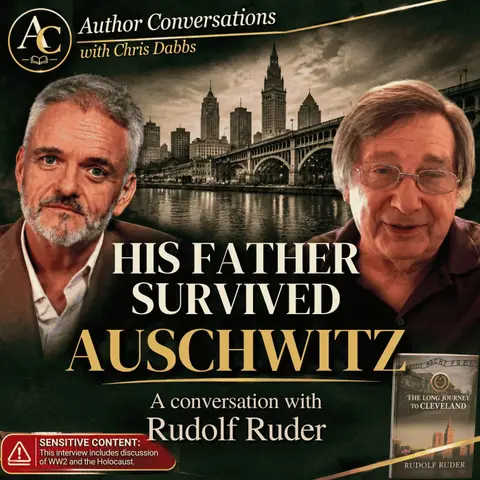
Rudolf Ruder's father survived Auschwitz and Dachau. His mother grew up in Nazi Germany and, as a young girl, presented flowers to Adolf Hitler. After the Second World War, they met, married and began a new life together in Cleveland, Ohio.
In this episode of Author Conversations with me, Chris Dabbs, Rudolf discusses The Long Journey to Cleveland, the book inspired by his parents' extraordinary and very different wartime experiences.
His father, Simon, was a Jewish tailor who survived imprisonment in a succession of Nazi concentration camps. His mother, Maria, grew up in Bavaria surrounded by Nazi propaganda. Much of their past remained unspoken while Rudolf was growing up.
We talk about his search through concentration camp records, the family stories he uncovered, unexpected acts of humanity, the circumstances in which his parents met and the importance of preserving these accounts for future generations. Rudolf also discusses the further family history he is now researching.
CONTENT ADVISORY: This episode contains sensitive discussion of the Holocaust, antisemitism, Nazi persecution, concentration camps, wartime violence and suffering during the Second World War. Some accounts may be distressing.
BOOK: The Long Journey to Cleveland by Rudolf Ruder
PRESENTER: Chris Dabbs
Watch the full interview on YouTube:
https://youtu.be/yIKW5OZCUEk
Rudolf Ruder's official Author Conversations page:
https://www.author-conversatio...
Every book has a story beyond its pages.
Author Conversations with Chris Dabbs is an independent interview programme presented by British broadcast journalist, presenter and newsreader Chris Dabbs. With more than two decades of experience in radio, television and digital broadcasting, Chris speaks with established and emerging authors about the lives and stories behind their books.
Official website: https://www.author-conversatio...
YouTube: https://www.youtube.com/@AuthorConversations
Verify official communications: https://www.author-conversatio...
#RudolfRuder #HolocaustHistory #TheLongJourneyToCleveland #AuthorConversations #ChrisDabbs
Become a supporter of this podcast: https://www.spreaker.com/podcast/author-conversations-with-chris-dabbs--6905413/support.
These are thoughtful, in-depth interviews that give authors the time and space to talk about their work, their lives and what they hope readers will take away.
Discover Author Conversations with Chris Dabbs:
Official website:
https://www.author-conversations.com/
Watch the interviews:
https://www.youtube.com/@AuthorConversations
Authenticity and verification
To verify genuine interview invitations, correspondence or requests made on behalf of Author Conversations, visit:
https://www.author-conversations.com/verify
Frequently Asked Questions
What is the book The Long Journey to Cleveland about?
The Long Journey to Cleveland by Rudolf Ruder tells the extraordinary true story of his parents: a Jewish concentration camp survivor and a German woman who grew up in Nazi Germany, detailing how they met and built a life together after World War II.
Who are Rudolf Ruder's parents?
Rudolf's father, Simon, was a Jewish tailor and Holocaust survivor from Livov who endured camps like Auschwitz and Dachau. His mother, Maria, was a German Catholic from Bavaria who grew up under the Nazi regime before they eventually met in postwar Germany.
How did Rudolf Ruder research his parents' wartime experiences?
Rudolf utilized a wealth of historical documentation, including records from the International Tracing Service, concentration camp prisoner lists, and even declassified U.S. Army Air Force bombing mission documents.
0:00 INTRO Hi and welcome to Author Conversations again. My name is Chris Dabbs, as usual, and my guest today is Rudolf Ruder, whose book, The Long Journey to Cleveland, tells an extraordinary family story from two very different sides of the Second World War. So, his father, Simon, was a Jewish tailor from Livov, who survived a succession of Nazi camps. His mother, Maria, grew up in Bavaria, surrounded by Nazi propaganda.
0:44 After the war, they met, married, and made a new life in Cleveland, Ohio. For years, much of that history remained unspoken at home. But Rudolph has now brought their experiences together, using family memories and historical records. Rudolf, welcome to Author Conversations. This is going to be a fascinating conversation, I think, and how are you today? I'm great, Chris. How are you? I'm okay. I'm doing well too. Thank you very much for asking. It's very kind of you, straight into the book. What made you decide that now was the time to write your parents' story? What did you discover about them in the process? Had they talked much about these things during the years when you were growing up? Everybody asked me that. In fact, I've been asking myself that question too. Of course, I weighed in till they both died before I wrote the book. I'm like, "Doh, I don't know that much about it." So I started doing research. There was a number of sources of research, the International Tracing Service, for some reason, kept a bunch of records. So I got most of my father's concentration camp records. All we knew growing up was he had a number on his left arm. We kind of knew that was something, but he never really talked about it, and we never really discussed it. So it was like when we got to America, that was all old history. We didn't talk about it. Well, I started becoming interested in it as I learned more about the Holocaust,
2:19 and having been born in Germany, I had a lot of relatives on the other side as well. But what inspired me really was the fact that what they went through, my father, as you mentioned, went through a succession of camps. He went through Dachau, Auschwitz, and a couple of other ones, and just barely survived most of the time. In fact, all the time he survived, but he was near death a number of times. So I realized that gosh, my parents lived through some of the darkest times of human history. I mean, it was pretty bad. And I wanted to learn more and more about it. And as I was learning my history, I thought, you know, I need to, if history is a canvas, I need to have my parents on that canvas.
3:08 What did they go through? These are real people going through history. So how did it happen? How did they meet? My mother was a German Catholic. She was in the Hitler youth. She gave Hitler okay of flowers, which have a picture of. So I'm wondering, how did they meet a concentration camp survivor liberated from Dachau? And my mother, who was 17 at the time, steeped obviously in Nazi propaganda, having met the fewer. And it's kind of interesting. How did they meet? I asked my mother, how could you marry a Jew? And I asked my father, how could you marry a Nazi?
3:50 So, you know, well, I guess it's love. So anyway, I wanted to know more and more about my family history. And that's what cuts me to number one, research it. And number two, I need to write this down. Maybe, you know, just as a family history, but for hopefully somebody to learn something from it. You know, how, how can something positive come out of something that was so negative? So that's basically why I wrote it. But that makes a lot of sense, we're tough. I mean, you know, well, in some respects, I think the questions over how your parents married or found each other and all that sort of thing. I mean, yeah, wow, that's incredible. Isn't that mean? How? You go from one side in Bavaria, as you say, being part of the hit in the youth to your dad and it's, you just can't credit it, but you must have found out a bit more.
4:40 Okay. And so, right. So what, let's start with your dad then. I mean, what did you know about the life he had before it was taken away from him, basically? I mean, you mentioned the records and testimonies and things like that. But he never told you anything himself. So you must have really researched the China. Yeah. Oh, yeah. The interesting thing is, you know, like I said, there's a wealth of information. Number one, the Germans wrote down everything. They kept records like you wouldn't believe. So I was able to trace his, pretty much his entire journey from 1941 on to 1945 when he was eventually liberated by the Americans. So I know exactly when he went into this camp, he went, he went into prison. What his prisoner numbers were? Who came in with him? The Germans published lists. Here's all the guys that came in. It's, it's incredible. What was there? Plus, there is some family history. I've got an uncle who about who I'm writing another book in his son. And they serve both, well, the cousins survived. And he's, he happened to have a lot of pictures and memories. So he's got a lot of memories of what he went through, basically as a five year old. But the bottom line there is I just did all this research as far as my mother meeting Hitler. She told me, she said, I met the Fuhrer and gave him a bouquet of flowers.
6:14 And she was from a little town called Mildorf, which was just a little bit east of Munich. So I'm thinking, well, why would Hitler visit your town? So, you know, I just, okay, I filed that away and when I was writing the book, I decided I've got to find out why. So I got in touch with the Mildorf newspaper. And one of the editors said, oh yeah, here's pictures. So he sent me a bunch of pictures. And he said, yeah, you can use them. I gave them, you know, I recognized them in the book as far as where the source of the pictures came. So like, okay, Hitler was on his way to Austria to announce what was called the Anschluss, which is the annexation. So got all that, got all that information.
7:01 My grandfather on my mother's side was a train engineer. He took Jews to the camps. A couple of her uncles were in the German army. One of them was in the first mountain division, which is kind of like the special, special troops. The SIS, or those kind of guys. And he was involved in capturing my father's town twice in 1939 and 1941. So there's some unknown family connections that we never even knew about. And they both got killed on the Russian front, liberating my uncle. So there's just all kinds of historical, I don't know if you want to call them coincidences or whatever. So anyway, so my mother is when she gave Hitler the flower, she was just about out of her tenth birthday ready to go into the girls Hitler youth to learn all about, you know, the superior, the master race and how the Jews and this love box were, Ultra mentioned, which is like subhumans, you know, the propaganda, that's how it works.
8:10 And who knew that they would ever meet? He's in Levov Poland. He's got a family, got two kids, Anna and Arthur and a wife Lola, which is an arranged marriage. He had a tailor shop in Levov, very successful, very, I guess, very active in the Jewish community. So he was kind of a leader there. And the story goes through how they're looking at what's going on in Germany and wondering what's going to happen to us. You know, they learn about Kristallnacht, where they had these big demonstrations against their Jews killed a bunch of them, burned down like 1200 synagogues. So it was pretty bad. So in Poland, the Jews are, you know, like what's going to happen to us. And of course, I go through some of the conversations that they might have had. My father, unfortunately, he wasn't a communist, but he kind of liked the idea of everybody being equal. And of course, if everybody's equal, then, you know, there's no anti-Semitism and everything will be happy. And there's a lot of different points of views of some of the friends that I knew about and some that I made up. It's historical fiction, but it's based on reality. So basically, what brought them together, oh my God, it's a long way to get them together because she's never seen a Jew. You know, she knows all about the Jews from
9:41 her indoctrination. And of course, the Jews were blamed for everything that was wrong with the world, blah, blah, blah, blah, blah. And some of that persists today, I think. But anyway, so, nobody could ever imagine that she would marry a Jew. And it was not a, it was a tough romance. They met after my father was liberated from Dachau. The Germans had said, and Dachau was, within like eight kilometers of where my mother lived. And of course, they were told bad people go there. So they really didn't know what was going on. Except for my grandfather, who took Jews there. And he saw the skeletons in the stripe, uniforms walking around. And he said, he would throw his lunch over the fence, which I gave him a lot of credit for in the book because had he been caught, he'd be in there with him. So anyway, so they kind of go their separate ways in the war. My father gets captured in Levov. Well, first of all, when the Russians came in in 1939, after the Germans told, there was a ripen off, there was, there's a treaty between Germany and the Russians, how they would divide Poland. So once the Germans attacked Poland, they turned it over to the Russians. And the Russians took over that part of Poland, the Galicia. So they would impose their system of economics and all that. My father lost his business and the Ukraine. There was a lot of
11:18 Ukrainians there and they had no love for the Jews. So there was a lot of murders and pogroms, what they call it. But my father and his family survived until the Germans attacked Russia in 41. So now things changed very dramatically for the Jews. In the thousands and thousands of them were killed. My father was captured and put in a very infamous jail. It's called Lonkey prison and he was made a slave laborer sewing SS uniforms because he was a tailor. So that saved him. So yeah, there's a couple of things he escaped, got captured again. An SS guard of all things saved his life there. Which is, my father tried to find the guy after the war and they wouldn't tell him where he was. He got five years in prison for being a SS guard. But yeah, that just shows that in light of all of this stuff happening, there's still some humanity there. He saved my father twice once in the prison and once at Auschwitz. But to make a long story short, my father was transferred from Lonkey prison to a place called Plazov, which I don't know if you're familiar with Schindler's list. But that was the camp where Isaac or where Schindler had his Jews. I come to find out one of my uncles was one of Schindler's Jews. So my uncle was working
12:54 for Schindler in the enamel factory. My father was passing through there at the same time and they never even made the connection. From there, my father was transferred to Auschwitz and this is where Mengele, the doctor doing the experiments, saved my father's life inadvertently. As the Jews were getting off of the trains, two SS officers kind of gave him a cursory look and said, "You either go this line or this line." One line, you were in a gas chamber within an hour. The other line, they thought you had some value that you could hang around until you died. So my father was sent to one the wrong line and Mengele, my father told me this, Mengele came and asked him, "What is your occupation?"
13:42 He says, "I'm a tailor." From Lemberg, Lemberg was the German name of Lavav. So my father was smart enough to use the German name. So Mengele apparently looked at him and said, "Okay, go over the other line." And that saved his life just way actually. Yeah. Well, you know, in these kinds of things, you have coincidences, you have providence, you have whatever. Something saves you. So anyway, so he winds up at Auschwitz. Near death, they put you in a block where you just die because they know you're not going to make it. And my father said, "Somebody brought him bread and soup." He didn't know who and said, "I'll be back." And a couple days later, brought him some more bread and soup, my father survived. And they took him back into the Auschwitz main building and they assigned him to repairing uniforms. And as he was walking down the hall, an SS officer walked past him and he told him, "Now you can thank me." And it was the same guy. So twice, he saved my father's life. So there was a death march out of Auschwitz in January of '45. This is a week before the Soviets liberated Auschwitz.
15:03 So I think 58,000 inmates were marched in the snow away from Auschwitz. And then the Russians came and liberated it. But he almost died on that death march if he couldn't keep up, they shot you. Then he winds up at Dachau. And that was no picnic either. So again, he's near death. So he survives the Americans, liberated him. They set up a makeshift hospital for the survivors at a, I think it was an expert convent in Mildorf, my mother's town. And this is like a mashing unit where they would take care of you and then send you to a better place, the hospital that had better facilities. At that hospital, my mother happened to be a 17-year-old nurses helper.
15:56 So she meets my father, bandages, crutches. And she starts talking. They start talking. She'd never met a Jew before. And he's, you know, he's very despondent. He's lost everything. And here's this very pretty German girl. And he speaks fluent Germans. So they start talking. And of course, the poop hit the fan because her family found out you're talking to a Jew. You can't do that. You know, so, oh man, that was terrible. So anyway, they start talking. That's how they met. That's how they met. And their romance was just, it was awful. The church was not happy with her.
16:39 Her family disowned her. I was born in a convent because, you know, oh my god, my daughter's pregnant and it's by a Jew. We got to get her out of here. So I went to a convent. I lived there for six months. And my father's trying to find my mother because he finds out he has a son, me. And my mother had a boyfriend who was in the German army. He got captured. Went to Siberia. It was one of the very few that got released. Comes back to try to marry her. He finds out she's got a son, by a Jew, me. And, you know, a lot of the prejudices come out in it. Very, very interesting. So anyway, that's how they met. Purely, you know, over five years, they were coming closer and closer together.
17:31 He was coming the hard way. And she was just saying, "You out there working for the government." So that's how they met. That's how you read the book for the rest of it. Oh yeah, fair enough. Wow. I mean, that is, that's powerful stuff, isn't it? I mean, my mind's racing. And thinking about it, it's like, you couldn't make a movie out of this, which by the way, we do have a movie deal. Probably the country here doing book signings and, you know, author talks. And it's kind of heartening to see how many people are still interested in this. Especially when I go to the Holocaust Museum in Washington, DC, there's people from all over the world. And they're just, they were talking and they're interested in this. They have their own stories and own questions. So it's very heartening for me to see the people take this, they still take this seriously. They understand the implications. You know, does history repeat itself?
18:35 I don't know, not getting into politics, but gotta be careful. All right, let's get in. You say it's historical fiction to a certain extent. When you go to these book signings, say when younger readers pick up a long journey to leave that. Right. What do you most hope that they'll understand about your parents then? The amazing story. And that history, it's a period that they went through. You know, I mean, it is, well, first of all, one of the questions you're going to ask is, why did I include my mother's story? Well, I had to because it's two halves of the whole, two halves of the whole. It's showing one side and it's showing the German side. Okay, it's showing the propaganda. It's showing that there is humanity. There is hope.
19:21 It shows the determination, the survival instinct. I have some notes here that one is pretty good. That look pretty good. I want the readers to understand how profoundly the environment in which he raised can influence you. I mean, obviously my mother, you know, she was all intimate Hitler. And then after the war, how two people from vastly different environments, I couldn't think of different environments came together and rebuilt and made a life. And what I want the younger generation to know is that the story, the story should be never, never take freedom or humanity or responsibility toward each other for granted.
20:11 My parents experienced World War II, obviously, from two different, completely different perspectives. My father suffered through blah, blah, blah. This, their experience, demonstrate just how destructive hatred, intolerance and prejudice can become when you're allowed, when they're allowed to flourish. Okay. I mean, we see things like that every day. But despite, despite everything my father went through, like I asked him, how could you marry a Nazi? You know, his friends were not happy with him. Really? Okay. So he had consequences. Oh, there was prejudices on both sides. And it wasn't, hey, congratulations. No, no, it was anything but like I you, Miss Sugar.
20:56 You know, my mother converted and the rabbi was a guest. He said, are you crazy? You know, if she's going to convert, she's got to go through all kinds of really questioning. My mother, when they first rejected me the first couple of times, she's thinking, how dare you? I'm a member of the master race. How can you reject me? You know, so we had all those kinds of things going on. But like I said, I am heartened that the younger generation is interested in this. Okay. It's, it's, it's kind of a microcosm of a lot of bad things and good things all together. Like, how do these people survive? I, to this day, you know, I, I just can't believe that I'm here because I am so close to not being here. Yeah. So that's amazing. I think, isn't it? I mean, you know, that you all hear it really because the way that you got together, I mean, yeah, it's not one you got a movie deal. Yeah. Yeah. The screenplay is done. The music is done. We just got to get the money to do it. And then on his environment, I'm not sure it's the best time with what's going on. But anyway, it's out there. And I just want future generations to learn that, yeah, there is hope in spite of all this. You know, there are people that have gone through suffering and survived the have persevered. So that's basically the message I want to get out there. Two separate ways of
22:29 going through the Second World War, your dad was just like, oh, incredibly, well, I was like, I don't know, lucky. I had, I don't know how I had to explain that, but fortunate, I guess, right? With all of those different coincidences, just going back to that guard who saved him in, in, in our foods. Yeah. So did he recognize him then? Yes, he did. He met in Lonkey Prison where the guard was an SS guard. It was an SS facility that was supposedly making SS uniforms. And because my father was a tailor, he had a group of tailors and they were making SS uniforms. Now, the funny thing is one day he got called into the comment down. This guy was really evil, but his wife wanted a dress for this big SS thing, big party. So they ordered my father to make a dress for her.
23:24 So he winds up through a lot of different avenues finding cloth in the ghetto or outside the ghetto, making a dress. And here, this is the picture I tried to paint. They're in the Commodance Office in his wife, very pretty German girl. You know, she didn't like the idea of even having the Jew in the room, but here's my father clutching this dress. So here's the evil commandant, the SS guard, my little father with a dress. And here comes the Commodance wife. She looks at the dress. She runs over, grabs it, and squeals with delight and runs in another room and all three men look at each other and laugh.
24:11 And they said, for a minute humanity broke up. That's gotta be the movie. Yes, I think so. I don't know. That's time, man. Honestly, you've moved up. I mean, that's so this, you've mentioned his historical fiction as well as, you know, his historical facts and things. What percentage fiction, what percentage fact do you think? I would say it's probably 75% fact in 25% fiction because obviously I wasn't there. I'm relying on, I mean, I've got some United States Army Air Force declassified documents of a bombing run they did in 1949 or 1945, August 19th.
24:53 My mother was running home from school. Air raid sirens came up, went off. She was with three friends, the three friends ran into her church because they knew there was a bunker of sorts. My mother decided to run home. The church took a direct hit, killed the three girls. I talked to the guy who dropped the bomb. It's incredible, isn't it? He gave me access to the declassified mission documents. I've got all the tail numbers, all the, all the planes that flew the mission. I've got everything. It's just unreal. And he says, here, I give you permission to use all this stuff. And he said, yeah, he said, I saw the first bomb went into the river and then the second bomb hit a church. And they said, yeah, that's the bomb almost killed my mother. So it just never know.
25:44 I love my gosh. Do you know what? We need to talk again. I think gosh, are you writing another book by any chance? I'm writing a book about my uncle and his son. Well, he mentioned. Yeah, the son is living in Florida right now. He was five years old. So I'm going through he and his mother hit in a bunker under a farm woman's stable for three years. And he's recounting the SS coming in, shooting into the hay, but the pitch forks and all that stuff. They never, they were never found. And he's talking about when the Russians liberated them. Again, this is through the eyes of a five to seven year old. And I've got them in the book, but I decided, you know, their story is we'd never knew much about my uncle. He never said very much. Then I started looking up his records and oh my God, he was in two or three different mini concentration camps. He worked with the partisans.
26:45 You know, doing sabotage against the Germans. All that. So I'm okay. I'm expanding their role because this deserves a book of its own. So I'm working on that. Then I'd like to like to fact then I had another uncle who fled to Cuba in the 20s because of some nefarious things he did in Poland. I met one of his descendants, Ophelia Rooter in Miami. She just recently passed it like 95 or something. And she was very, they called the Cuban Jews, Jubens. They thought that's what they called themselves.
27:31 And she was one of the leaders in their naming a street after her. And then another one of my gosh, another one of my relatives was the middleweight boxing champion of the world. In the 1940s. It's like, wow, when you start pulling that thread, there's all kinds of things that fall out. So I didn't play that. Yeah. Sorry. Go ahead. You love to find out more about my uncle Isaac. He moved to London after the war. Okay. And he died in 1985. But he was one of Schindler's Jews. And I met him, but he never talked about anything. He just, but yeah, his name appears on there, the birthday and the town of origin. And also if you watch Schindler's list right at the end, Schindler gives everybody a big bolt of cloth. And that bolt of cloth he gave to my uncle Mendel in 1950. So it's like, oh my god, this all ties together. So yeah, amazing. Oh my gosh, what did this Rudolph? I'm so sorry, but we have run out of time. I can't believe it. I'm just flabbergasted. And I think readers and listeners and watches and everybody you're going to be flabbergasted too.
28:51 So Rudolph, Rudolph, thank you for sharing your parent's story with me and everyone else as well. Your book is called The Long Journey to Cleveland. And it's a remarkable reminder of why these family histories matter. And why it's important that they are preserved. Thank you so much for joining me. I really appreciate that. Thank you. No, not at all. Just quickly before we do go, what about your social media? Can people get in touch with you online? And where can they buy the book? I have a website. It's The Long Journey to Cleveland, all one word.com. That'll give you where to buy it. It'll give you a lot of information about the book. Again, why I wrote it, why I think it's important. And the reviews have been really good. 4.6 out of 5 on Amazon.
29:38 It's been doing well. It's been doing well. I'm surprised. I sell a lot of them at book signings. I sell some of them out of my trunk. My boot, I know it. My boot, I'm sorry. Yes, for us for us, Brits. Yeah, yeah. That's right. Yeah. All right. Bye, listen. Great to meet you. And thank you very much for joining us on Author Conversations again. Take care. Bye. Bye. Bye. If you enjoyed this conversation, you can watch more author conversations here. [Music]