
Ancient Petroglyphs: What Do They Mean? | Clay Brough

 iHeartRadio

 Apple Podcasts

 Spotify

 Amazon Music

 Deezer

 Podchaser

 Spreaker

 Castbox

 YouTube
Key Takeaways
- Author Clay Brough explores the ancient petroglyphs of Utah, examining how markings in the Uintah Basin and around the Rochester Creek panel connect to the surrounding landscape.
- Through extensive geomapping and satellite analysis, Brough discovered that many ancient petroglyph patterns correspond directly with geographical formations only fully visible from the air.
- While traditional archaeology views these rock art sites through cultural and historical lenses, Brough's research suggests an intricate geographical code embedded within the carvings.
- The conversation bridges ancient mysteries with modern intrigue, touching upon the unexplained phenomena and stories associated with Utah's famous Skinwalker Ranch.
- Brough emphasizes that interpreting petroglyphs made thousands of years ago remains a complex puzzle, with theories ranging from human record-keeping to more speculative origins.
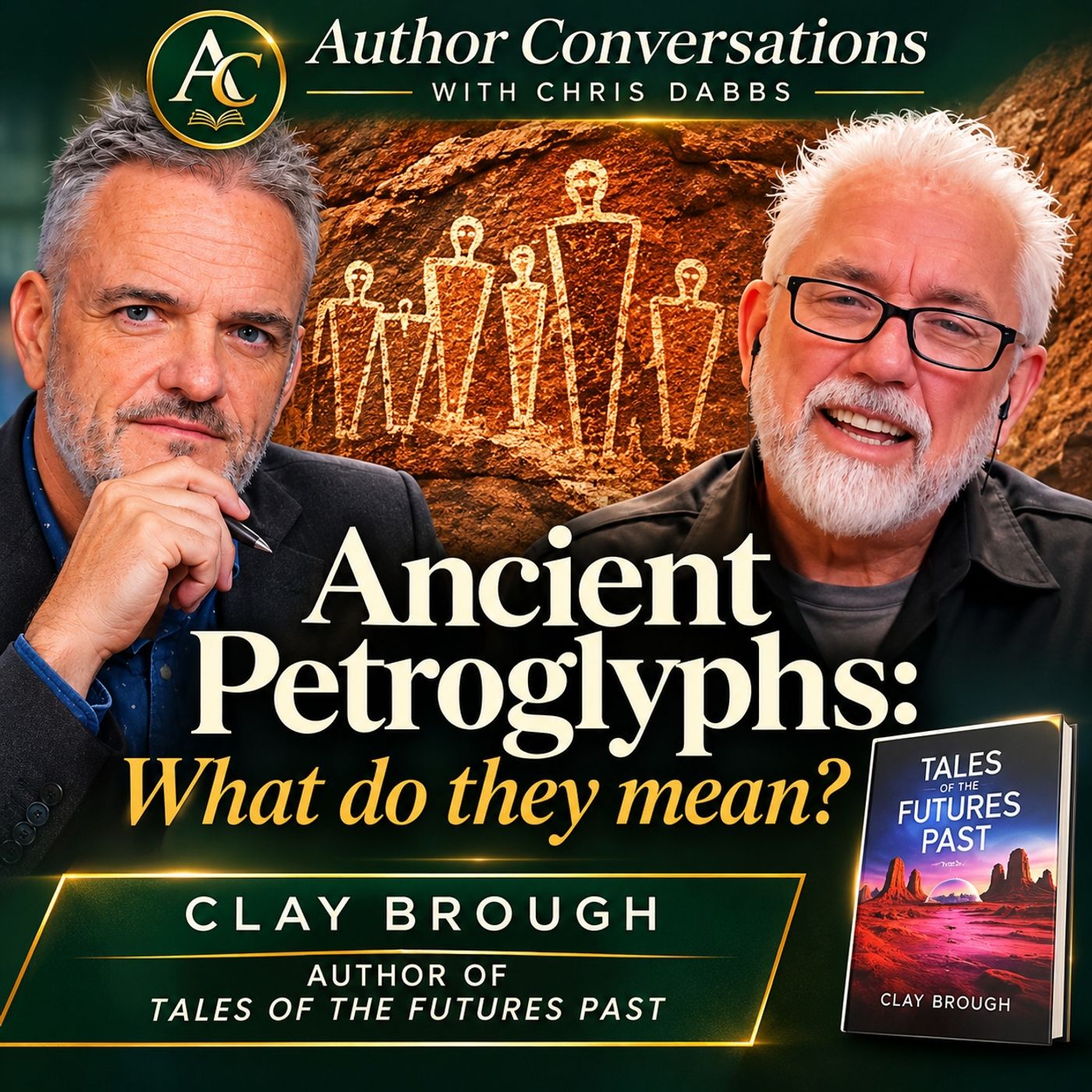
In this edition of Author Conversations, I talk to Clay Brough, author of Tales of the Futures Past, about his interest in rock art, the questions raised by the Rochester Creek panel and the ideas that have shaped his research and writing.
We discuss the Uintah Basin, possible connections between the markings and the surrounding landscape, and why interpreting images made so long ago is far from straightforward. Clay also talks about the stories and mysteries that have captured his imagination, including those associated with Skinwalker Ranch.
It's a conversation about the past, the evidence we have and the different ways people try to make sense of it. Clay's interpretations are his own and should not be mistaken for established archaeological findings.
Watch the interview on YouTube:
https://www.youtube.com/watch?...
Clay's Author Conversations page:
https://author-conversations.c...
Book featured: Tales of the Futures Past by Clay Brough
More interviews and information:
https://author-conversations.c...
Become a supporter of this podcast: https://www.spreaker.com/podcast/author-conversations-with-chris-dabbs--6905413/support.
Every book has a story beyond its pages.
In Author Conversations, broadcast journalist, presenter and newsreader Chris Dabbs sits down with the writers behind some of today’s most fascinating books to uncover the research, experiences and ideas that never made it onto the printed page.
Featuring bestselling and emerging authors from around the world, each episode goes beyond the blurb to explore the real stories behind the writing.
From untold historical discoveries and groundbreaking scientific research to personal journeys, business insights, faith, true crime and the human experience, every conversation is designed to inform, challenge and inspire.
Drawing on more than two decades of professional interviewing across radio, television and digital journalism,
Chris creates thoughtful, in-depth conversations that give authors the time and space to tell the stories that matter most.
Whether you’re searching for your next great read, fascinated by the creative process or simply enjoy intelligent, long-form conversations, Author Conversations offers a unique opportunity to discover the people, ideas and experiences behind remarkable books.
Real authors. Real stories. Real conversations.
Frequently Asked Questions
What are ancient petroglyphs?
Petroglyphs are images carved into rock surfaces by ancient peoples, often depicting figures, shapes, and symbols whose original meanings remain open to various interpretations.
Where is the Rochester Creek panel located?
The Rochester Creek panel is a major rock art site located in Utah, serving as a key focal point for researchers studying the region's ancient petroglyphs.
How does Clay Brough study petroglyphs?
Brough uses a combination of modern satellite geomaps, aerial photography, and sketching techniques to analyze the intricate lines of petroglyphs and match them to physical geography.
What is the connection between the petroglyphs and Skinwalker Ranch?
Clay Brough's research into Utah's Uintah Basin led him to examine petroglyphs near Skinwalker Ranch, noticing geographical patterns that connect the surrounding rock art sites.
0:00 Hello and welcome to author conversations again with me, Chris Daabs. Ah, well, do you know what? There are ancient markings carved into the landscape of Utah in the US. There are figures, there's shapes and symbols whose original meaning is still open to interpretation. We've got no idea what they are or do we? Because some people see archaeological records. Others they wonder whether these carvings might tell us something much bigger about the people who created them, you know, kind of things like what they knew, what they believed and how they understood the world around them. My guest today is Clay Brough, whose book Tales of the Future's Past looking from the outside in, takes us into Utah's Uintah Basin.
0:46 It takes us into Utah's Uintah Basin, the Rochester panel and the landscape around Skin Walker Ranch. I've heard of this SkinWalker ranch thing, but we'll get into that later. It's a journey through ancient symbols, it's a journey through modern technology and some fascinating questions about the past. I cannot wait to get into this. Clay, welcome to author conversations. You believe how good it is to have you with us today. How are you doing? Oh, pretty good. Today's pretty an awesome day. I'd finally get to get to around this book and talk about what it's all about. Yeah, good. Well, I tell you what we are looking forward to it. I've got to say, on behalf of viewers and listeners and me, especially, I'm so excited.
1:29 Okay, let's get straight in there, because what I want to know is what first kind of drew you to these ancient carvings, right? Was there a particular moment where you thought there was something here that you really needed to understand, or was there one site or marking that set you on this journey? I mean, during your looking Utah as well, oh my gosh, there's too many questions. But what made you start anyway? Well, pretty much about 10 years ago, I started doing research on my dad. And my dad is originally from Utah. He was born, raised there in Tremont, Utah. And so I decided I'm going to go take a little look over there. And in that process, I decided I'm going to, you know, I'd do a lot of geomaps.
2:14 I'd get on the internet and I'd do a lot of look at around. So I decided I'm going to cruise on over to Skinwalker Ranch area. Just kind of look at it because I was part of their little media show for their show. And so I go over there and I start to look at it at Skinwalker Ranch. And I noticed that the Rochester panels and other petroglyphs started matching up to the UN a basin. And so, you know, so I had to do some, you know, placing and looking around.
2:55 But I noticed that they started matching up with UN a basin and more and more of the petroglyphs started showing up. And so it was just, it's just kind of a weird thing because I was raised on, I mean, when as I'm being raised, my grandparents had a lot of maps and, you know, like 2D maps and 3D maps and globes and stuff like that. And I'm going, after all these years, I'm thinking, why do they have all these round? And so I just started paying attention to them. My mom had them, my grandmother had them and other people had them. So I just started paying attention to a lot of maps.
3:37 And then over the years, you know, when you're driving around, you start figuring out how to work maps and everything. And so I just started noticing all this stuff. And so, all these petroglyphs just started, you know, just like showing up and into the geography of the UN a basin. And so then I just started doing more and more research on petroglyphs. And from Colorado to Arizona, Nevada and Utah, all the petroglyphs that are created in those particular states, everything that they're showing tends to, what's the word for it.
4:24 Keep going back to the UN a basin. And so every time I see one of these pictures, now just say like this picture right here. I don't know if you can see this picture. Okay. That picture right here is you can probably touch the ranch from there. That's how close this particular petroglyph is to their ranch. And by looking at the lines and everything that come up through here, that's all geography. And every petroglyph that I've ever seen yet has geography in it. It's really hard to explain, but every one of them have geography and then there's the story and then there's the events and everything that's talking about the petroglyph.
5:12 But it all comes down to the geography of the part of the petroglyph. And so that is what is very intriguing to me is how all their geography is coming up in another petroglyph to where this can tell you from a geomaps from the satellites and everything. The only way that you can see these is from there. You cannot see any of these pictures from the ground. So that's an aerial photo then, is it? That's an aerial photo. Every one of these petroglyphs you see are from the air.
5:55 You cannot see any of these from the ground. And that's how I discovered all this stuff is. And when it comes to the Rochester panel, how I discovered how it all works is I did my own real research going to Utah because I have family there and everything and I'm all Utah. I went there and I started doing a little research on some of the markings and stuff that's on the actual petroglyph of the Rochester panel. And it took me right to those places of the diagrams that are on the petroglyph.
6:38 And so that's what convinced me all of this is geography. They are telling a story but it's all about the geography and what happened with the events and everything happened at the time of all this being placed. I don't know if you understand it. It's a lot to understand but it's all about geography is what it really is. Okay, so let's try and put this into some sort of time then. We're talking about, well obviously we're not talking about 500 years ago for these things always. We're not talking about thousands years because anyone actually dated the geography around it and all that sort of stuff. I think some of them have been dated but I think it goes a lot further than just a few thousand years ago.
7:28 Because the intricacy of a lot of these lines and stuff, people could not do that. I'm not saying it was ET or Indians but people at that time could not carve that intricate of lines and stuff that's on these petroglyphs. So I guess as you say, these are carvings. And if they were done, I don't know, before the western kind of stony bronze age, even the bronze may not have been able to carve stone like that.
8:09 I don't know what stone that is of course but it's got to be quite hard stone because it hasn't worn by the looks of things. I think it's one of those things, isn't it? It must be amazing to stand in front of those or look down on them if you're going to see them from the air. Let's try and understand the Rochester panel. Is that in the same place? Is that in the Unita basin? It's actually about 200 miles away. Right, okay. Good. It's about 200 miles away from the actual site. But that particular panel is the main panel of all the petroglyphs.
8:54 And that's from my experience in all the research that I've done over the years, that is the main panel of the Unita basin. Now everything else is what is pulled into that petroglyph. It's kind of like looking at the United States. It's like looking at the United States and everything else is inside of that. And that's basically what all those petroglyphs, everything is inside of that. Not just that one petroglyph but in the Unita basin. And that represents the whole Unita basin. Wow. Okay. Yeah, it's pretty.
9:35 Now, Lord, you see, you know what the problem is, right? I'm thinking of all these questions. And I'm thinking, oh my gosh, we've only got so much time to talk about them because we need to do a podcast together. And so I was like, the different layers and markings on this. They make it harder to work out what they mean, I guess, right? I mean, have they not weathered? I mean, how much of this is, you know, inside protected? You know, like in France, right? I know that there are caves in Europe, around Europe. There are caves. And I'm sure there's the same in North America where they discover these things and you know, they go, wow, it's amazing. And obviously they close the caves off eventually because people ruin them with their own sweat and humidity and all that stuff.
10:20 But how, you know, they've managed to last so long, haven't they? So. And of course, this does mean that we've got to wonder about how they were made and what they were carved with and stuff, right? Okay. And so what makes you move then from saying, wow, that looks good. That's interesting because of course, I guess that when you looked at that first off and you could see, is it, is it like a red coloring and ochre coloring or something with it? It's like the tarnish. Yeah. Right. So that's been added, I guess, right? That must have weathered off at some stage. I presume. Yeah, but I think, well, whatever's happening or however that varnishing's gone on because people talk about how the sun could have burned it over the years, you know, kind of like burned.
11:10 But I've noticed it's only in the areas that are where there's petroglyphs. So my discovery on how these put together, some of these are put together is that whatever it was, thousands and thousands of years ago, burnt and carved in the rocket self and put it to where it's supposed to be kind of like, so a hard work, but by design. Okay. So they put it there and then all the little sketching and everything came afterwards. Now, I can't tell you if it was Indians, I can't tell you if it was aliens or ET, but something put it there.
11:57 And if we don't have that technology, thousands of years ago to be able to chisel in specific markings in that rock, then who did it? Now you say that it's kind of like a, it's happening, it's happened like a kind of tattoo where they've gone into it and the underlying pigment or whatever you called it is coming through. Okay. But that's interesting, isn't it, really? I mean, so what made you think then when you're looking at these and you go, "Oh no, that's interesting." But what made you suddenly start to think that, wow, hang on a second, there might be this deeper meaning of who did it, was it aliens, was it humans, was it whoever? I mean, what made you start thinking about that?
12:40 Well, I don't know, that's kind of a, I don't know one of those questions. It's a, I don't know how I started thinking about it, how it could be, how could it be ET or if it could be humans. It's a difficult one though. I know, I get it because of course you look at it and then you think, "Wow, okay, fine." But was there some evidence or something that made you think, "Yeah, that persuaded you really rather than simply intrigued you." I mean, we can all, we can watch TV shows for instance and then someone will say, "Oh, yeah, blah, blah, blah." In the past, some people blah, blah, blah, blah, came along and did it and you think, "Oh, yeah, that sounds plausible."
13:22 But in your instance, is there something you saw and you just thought, "You know what, that really has to be whatever it is that particular thing might have been?" I think so, but how I discover a lot of this stuff is, I don't know if when you're a kid, when you're in school and you get bored because whatever the teacher's saying or whatever you get bored, so you start etching stuff and you start drawing little things. Well, I have this saying all in the past of where I used to take pictures and I just marked, you know, just start going over lines and over lines and over lines.
14:03 Well, I take these petroglyphs and I start like taking like sketching paper and you pay over the quick pictures and you start sketching them and then things just start showing up and then once they start showing up, then you start noticing, "Wow, this is the same thing as that is." So, that's where I start picking up. So, here's just a little example. Okay, I take a light box, I take a light box and see, here's the picture, then you take this and you start marking everything out and then you take this and there it is.
14:49 So then you start looking at certain figures like this and lines like this and these lines right here and how all of this worked and when you're looking through satellite and you're looking by focusing in and out at a certain area, you will find these spots and a lot of times people don't understand how to focus in and that's the biggest problem is knowing how to focus in on what you're looking for and what you're looking at. And so, I take and I mark everything up, I edge everything and then I start putting it all together and then that's how I found out. Now I can take almost, I'm going to say about 75% of petroglyphs like this and I can place it into an area until you where it goes.
15:45 So this picture, just say if this picture is 100 miles away, I can still take you this picture and place it to where it's actually at in life, in reality, where it's actually at. It's crazy, but I can. That's because you've been there. You say that? Yes, I've been there. Yeah, yeah, yeah, exactly. Oh wow. Okay. So, just to get my head around this because I think what you're saying is as well that those petroglyphs also appear elsewhere exactly in the exact same way. So that particular one, for instance, appears on that Rochester panel as well.
16:26 Is that what you said or if I got that wrong? Yeah, it's on the Rochester panel. And there were several like that, right? So in other words, there could be hundreds of miles apart and yet someone has copied them, someone has copied them and put them all the other way around. Would I found out? Is I? I'm going to go online and he's constantly placing petroglyphs on there constantly every day. And I'm going, wow, and this is all in Utah. And I've seen pictures that are basically talking about the same thing but did put together differently. And then I could take that one because of the geography and I'll take that particular picture and it places in the same place.
17:12 So not every one of those petroglyphs are not saying that they're different or they're the same but I've had the same things, same petroglyphs but put in a different way. Like, okay. You know, the geography part and then it's basically telling two stories in one place. And so there's so many out there and I've seen thousands of them. And it's just like I said, they all still seem to run into the same place. Would you mean by running to the same place? Like point to the same place?
17:54 Like point to the same place like the UNA basin. So within about a thousand miles of UNA basin, you have all these petroglyphs through all these different states and most of them are related to the UNA basin. I can take almost any picture of any of those petroglyphs and place it where it's supposed to be. It's like a puzzle. Taking a puzzle, you got this particular piece and you can't figure out where it goes, that's me. It sounds like I'm good hobby to me.
18:34 I've seen thousands of these and it just blows my mind every time I look up a new one. Yeah, I'm not surprised. So let me see. Obviously I pick up all sorts of things doing this job and it's great to be able to talk to lots of different people. And so in Australia, for instance, you've got Aboriginal carvings or cave paintings or whatever you want to call them. It's like elsewhere. And I think they've always mentioned things like, I think for the Aboriginal of Australia, it's just something about telling people the kind of food you can find in that particular area. Like here comes, I don't know, mammoths or big kangaroos or whatever it is they had there.
19:17 But in this area, you can find this. So it's kind of like a, not a road map, but like a signpost. I guess in the US, when you're going along a highway, you're coming up to a turn off, then your sign say, you can eat here, you can have that there, you can have that. It's kind of like that, I guess. But for people 30,000 years ago, is that what you think these are? I mean, have you got any idea what these are? That's the $60 billion question, right? I don't know if it's really hard to determine why they are here. They could be future, they could be past, they could be present. But nobody really knows. I mean, everybody has their own ideas and their own theories.
20:03 I've listened to a lot of scientists, a lot of people talking about all this stuff. They talk about what's on the petric list. They talk about the colors. They talk about everything else, but nobody's really looking at the geography part. Because if you think about it, every one of those pictures, if they're telling a story where is that story being told at, it has to be part geography. And so that's where it all comes in. So I don't know what they're actually telling you, but the geography is the unibason.
20:44 Okay. So you're not talking about the geography in terms of the geology, I guess. But the stone is, you're saying that the fact that it's where it is is the important part. Yes. Yes. Right. Okay. And the stuff that's being written like the figures, like the animals and the human looking figures and stuff like that, I can't tell you, I can only tell you very little bit because it tells me a lot there's a story there and it tells how they're all placed in there.
21:24 It tells me what they're looking at, how they're doing it and where they're going with it, but they're not telling me when we're and when. Why? Yeah. And why? So there's a big geography picture there that all of these petric lists are telling little stories in one place. Okay. I guess you just say it's just in one place. Yeah, right. So how big are these? If you can see them from the air, some of these are very big, right? So they like the, what they call it in South America, you know, the incalign, not the incalign, the NASA clings.
22:04 The NASA clings. The NASA. Yeah. I mean, are they big like that? You know, people used to say there were runways and all that sort of stuff. Oh, it's just landing sites. No, they're not that big. They are big to an extent, but they're not that big. That's why you have to learn how to focus in on certain things like, uh, gotta wish I had another picture, but I know these pictures in the background right here. They have certain lines around them. I mean, basically, I think that if they're that big, right? You can see them from, uh, from the air and there are small ones as well, which, you know, you obviously can't see from, well, you can't, we wouldn't be able to see from satellites and things like that.
22:49 Um, I think that it's, it's interesting to know how that might go with this skin walker ranch thing, right? Yeah. Um, because I mean, I've heard of, I've heard of it and I kind of, what is it? It's like, what is it? Is this one to do with UFOs or something like that? Yes, the skin walker ranch has a lot to do with their scientific discovery of UFOs on the property. And what they call skin walkers and skin walkers are, I guess what they say is people or Indians that basically sacrifice theirself in a ritual or a, uh, which doctor type of thing.
23:37 And basically turn them into what they call a skin walker. Skin walkers, I guess, are half dead people and they don't look a lot like humans. Their faces are a little disfigured. Their legs are pointed kind of backwards like a, uh, I guess a, a dog or a goat type of thing. And they wear all this Indian, uh, dressing stuff and they, they're only, the only time they're ever seen is like after midnight out in the middle of the dark. And that's how people are seeing weird little things like that.
24:18 But that's what they call a skin walker. So I mean, uh, they have the dome. I don't know if you can see the dome over here. The dome they house will are checking out. And, uh, the way that they found this is their, their, their style of the digital world. You know, I'm not into the digital world. It's set for Google maps. That's the only thing that I work with. There's is discovering everything on that, uh, that all that right there is the unibasant and right here at the bottom is a skin walker ranch.
24:58 And that's a 2000 foot dome that they discovered and they can't get, uh, drones to go in it and they can't get drones to come out of it. And there's a whole bunch of things that are really weird about it. That, you know, they've, they've had smoke, they've had, uh, fire, they've had everything trying to figure out what this dome is. And so that is a big major thing. Their on skin walker ranch basically is that drop, drop, drop, that dome mainly. Wow. And they're, they're trying to figure out why and why is it there?
25:40 You know, I've never heard of that. I've, I've, I've, I've not heard of that before. That is fantastic. I love it. Oh my gosh. Okay, the only problem is we're starting to run out of time. I know. But you know, this is absolutely incredible. Um, I, I honestly, I'm off to Utah, right? That's it tomorrow. I'm booking a flight. Um, okay. But I, do you think then that after you've, we're going to have to start closing this off. I'm afraid. Yes. We're in. I know. But, you know, having spent so much time exploring these is clearly your passion. I mean, what's the one thing about an artist's past that you'd most like to know?
26:21 I mean, I think I might know what that is. But what is it that you would like to know? Um, why? Uh, basically, yeah. Why? Why? Why are, why is anybody else other than humans trying to communicate with us? If it's ET or if it's humans and why it was there in the first place, why, what are they trying to explain? And why are all the other petroglyss trying to do the same thing, explain why they're in these particular spots and what the whole process of, uh, and why the petroglyss are, uh, I, don't know the word for it, aren't.
27:12 Yeah. Why they exist. Why they exist. Yeah. Period. And why do I have these specific skills to understand? 90% of it is all about geography and not so much what they're saying, but it literally will tell you where it's at and in its placement and everything about the petroglyph. But I can't, like I said, I can't tell you what's, they're actually saying on the petroglyph. I can just take you to what it's telling you. Yeah. Well, you know, I think at the end of the day, that's something that we've all got to try and do, isn't it?
27:54 It's to try and understand it and work together, I think, as a, as a civilization to try and understand these things. But oh gosh, kay. Oh, time is, ah, yeah. We need to be looking at this. Again, I think, I mean, are you looking at doing, ah, or writing another book? Yes, I am. Some of it's similar to this, but I'm also going to do a, ah, for guys' books. The book or Nordio book or? No, I actually have an audio book. Oh, yeah. Yeah, I have audio books. I have my regular books. The thing with, what I did want to talk about to, sorry, the, if we're closing this out pretty close, is the book, ah, and of talking about the tales of the future's past and looking from the outside in, I hope everybody enjoys it.
28:46 It's one of those books that will suck you in. And hopefully everybody likes the, the story of the lines and, ah, it's very educational. It's fantastic. People can buy that on Amazon, I guess, and all that sort of good stuff. Yes, you can get it on Amazon. Um, Google, yeah, and so, but I do want to mention one thing, ah, that with every book that I sell, I want to donate a dollar out of every book that I sell to cancer research. And because I have so many people in my, not just my family, friends and everybody that have a lot of, a lot of different types of cancer.
29:31 So trying to promote this book and trying to, to help out, to, you know, and donating and trying to, you know, see some of the people live a little longer, a little longer. Yeah, exactly. If we can, you know, um, that's a nice thought as well. Um, but no, that's great. So how can people find you online, then, apart from putting your name in, ah, have you got a website or any other? Um, I'm working on my website right now. You can find anything and everything you need to just by looking up my name or the name of the book. Uh, my name is Clay Brough and the book is Tales from the Future's Past looking from the outside in.
30:12 Thank you very much indeed for joining me on a very frustrating 30 minutes because I've got so many questions. I'm sure this is a year's of all. So got that. But just to remind everyone, the book is Tales of the Future's Past looking from the outside in. Thank you, Clay Brough. Thank you for watching all the conversations with me, Chris Dabbs. I hope you'll join me again soon and I hope that Clay and I meet again very soon as well to discuss. I also too. This was pretty awesome. Brilliant. I'm really glad you enjoyed it. And folks, I hope you enjoyed it too and I'll see you again soon. Bye bye. Thank you. If you enjoyed this conversation, you can watch more author conversations here.
30:56 [MUSIC] [BLANK_AUDIO]