Should Authors Pay to Be Interviewed? The Truth About Professional Interviews, Publicity and Free Editorial Coverage
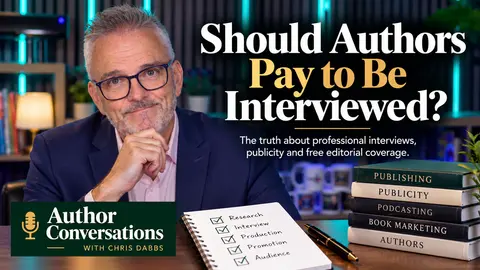
Should Authors Pay to Be Interviewed? The Truth About Professional Interviews, Publicity and Free Editorial Coverage
By Chris Dabbs | Author Conversations
When an author challenged the ethics of paid interviews, it raised an important question. As a broadcast journalist and presenter of Author Conversations, I believe it's a conversation worth having. Here's what actually goes into producing an author interview, what a professional feature provides and why we're also creating opportunities for writers to be heard without paying a penny.
The Email That Started a Conversation
A few days ago, we received a rather strongly worded email from an author.
We'd been in touch with him because people have been impersonating Author Conversations, using our name and my professional reputation to approach writers with fraudulent invitations.
We wanted to reassure him that the approaches he'd received were not genuine and that we were doing everything we reasonably could to alert authors to the problem.
Then he discovered that the real Author Conversations offers paid professional interview packages.
He wasn't impressed.
He questioned how we could warn authors about scammers while charging between £400 and £700 for our own services.
The language he used was considerably more colourful than that, but beneath his anger was a perfectly reasonable question.
If you're a legitimate interview programme, why are you charging authors to appear?
It's a question worth examining, particularly at a time when writers are being bombarded with publicity offers, podcast invitations and promises of exposure.
And I think we need to start by making an important distinction.
Traditional Journalism and Commercial Interviews Are Not the Same Thing
I've worked in broadcasting for many years, including with the BBC, ITV News and Times Radio.
Throughout that time, I've interviewed countless people without asking them for a penny.
That's how traditional journalism generally works.
A journalist identifies somebody with an interesting story, invites them to contribute and produces an interview because there's a genuine editorial reason to do so.
The broadcaster or publisher covers the costs of making the programme, usually through licence fee income, advertising, subscriptions or other funding.
But there's another perfectly legitimate model.
An author, publisher or publicist may commission an experienced interviewer and production service to create a professional feature that supports a book launch or wider publicity campaign.
In that situation, they're not purchasing independent editorial coverage.
They're commissioning a service.
And that distinction is fundamental.
At Author Conversations, we offer professional interview packages alongside our developing editorial programming.
We don't sell favourable book reviews. We don't promise bestseller status, guaranteed sales or that one interview will somehow transform an author's career.
What we offer is the opportunity to commission a professionally researched, presented and produced broadcast conversation.
And there's rather more involved in that than sitting in front of a camera for half an hour.
What Actually Goes Into an Author Conversations Interview?
One of the misconceptions about podcasting and online interviews is that the recording itself represents most of the work.
It doesn't.
A 30-minute interview is simply the most visible part of a much longer production process.
1. Researching the Author and Their Book
Before I interview somebody, I need to understand who they are, what they've written and why their story might interest an audience.
That means studying the material provided by the author or publicist, exploring their background, examining the book's themes and looking for the things that make this particular conversation worth having.
Sometimes the most interesting story isn't actually the book.
It might be the author's personal journey, the circumstances that led them to write it or something they've learnt along the way.
I've interviewed people who published their first novel in their nineties, writers who have overcome extraordinary personal difficulties and authors whose experiences have taken them into worlds I knew very little about before meeting them.
The preparation is different every time.
And that's exactly as it should be.
2. Preparing a Proper Editorial Interview
I don't particularly enjoy interviews that consist of somebody reading a list of predictable questions.
You know the sort.
What inspired you to write your book? Who's your favourite author? What advice would you give aspiring writers?
There's nothing necessarily wrong with those questions, but they rarely produce the most interesting conversations on their own.
For Author Conversations, I prepare a bespoke editorial interview plan.
It typically includes a carefully considered introduction, a structured sequence of questions and potential follow-ups that allow us to explore the author's story naturally.
I'm also looking for moments that might work independently as short editorial extracts.
A thoughtful answer about something an author has learnt, for example, might become a valuable contribution to a future programme.
But the interview itself should never feel like an interrogation or a marketing exercise.
It should feel like two people having a conversation.
3. Recording the Interview
Then comes the recording.
There's the studio environment, cameras, lighting, microphones, recording software and all the technical arrangements necessary to produce professional audio and video.
And, of course, there is the interview itself.
This is where experience matters.
A good interview isn't simply about asking a question and waiting for somebody to finish speaking.
It's about listening carefully, recognising when an answer deserves further exploration and knowing when to stop talking.
One of the nicest things authors regularly say to me after we've finished recording is that they've actually had the opportunity to speak.
Some tell me that previous interviews have felt rushed or that they've rarely been given the chance to explain what they really wanted to say.
Others simply tell me that they felt comfortable.
I regard that as one of the most important parts of my job.
The author is the guest. The conversation should be about them, not the presenter.
4. Editing and Post-Production
Once the interview finishes, another stage of the work begins.
The recording needs reviewing.
There may be interruptions, connection problems, technical mistakes or sections that need attention.
Audio levels need checking. Video and audio may require adjustments. Titles, branding and other production elements have to be incorporated.
Then the completed programme needs reviewing again.
Depending on the commissioned package, additional work may include creating shorter video extracts, promotional graphics or other agreed materials.
Each of those elements takes time.
And although modern editing technology can make parts of the process considerably more efficient, it doesn't remove the need for somebody to oversee the finished result.
5. Publication and Promotion
Finally, there's preparing the interview for its audience.
An episode needs a suitable title, an accurate and engaging description, appropriate artwork and the relevant links and information.
It must be prepared for publication on the agreed platforms.
Where additional promotional material forms part of the package, that also needs producing and delivering.
And throughout the process, there's communication with the author or publicist, scheduling, administration and the inevitable technical issues that occasionally arise.
So while the interview itself might last 30 minutes, the complete production can involve several hours of work.
That's before accounting for the professional equipment, software subscriptions, hosting and other running costs.
Which brings us to the question of what the author actually receives.
What Does an Author or Publicist Get for Their Money?
At Author Conversations, our professional services currently begin with the Professional Author Feature at £395, while our Premium Launch package starts at £695.
These are commissioned production services.
The precise deliverables depend on the package selected and the arrangements agreed with the author or publicist.
At the heart of the service is a professionally presented interview that allows the author to discuss their book, their ideas and the experiences behind their writing.
Depending on the package, the commissioned work may also include additional production and promotional materials.
For an independent author, that can provide an opportunity to participate in a professionally produced broadcast conversation without having to organise the entire production themselves.
For a publicist, the interview may become one element of a wider publicity campaign, complementing reviews, media appearances, articles and other promotional activity.
But there's something I want to make absolutely clear.
A professional interview is not a guarantee of book sales.
It isn't a promise of bestseller status, a favourable review or coverage by other media organisations.
And any producer making those sorts of promises should be questioned.
What an author is commissioning is the professional service and the deliverables specified in their agreement.
Whether those materials ultimately help sell books depends on numerous factors, many of which are beyond the control of any interviewer or production company.
For some authors, the investment will make sense.
For others, it won't.
And that's perfectly fine.
Shouldn't Authors Be Interviewed for Free?
Yes.
And many are.
Authors contribute their own expertise, experiences and time to interviews. Without them, there wouldn't be a conversation in the first place.
It's entirely reasonable for a writer to question why they should pay to provide the very material that makes a programme interesting.
Indeed, I think it's a question more people in the industry should be willing to discuss.
In traditional journalism, the decision to interview somebody is generally driven by editorial interest.
The author isn't commissioning the coverage, and the journalist isn't providing a paid promotional service.
But independent media production has its own financial challenges.
Equipment, editing, hosting, research and presentation all cost money.
Some programmes are supported by advertising or sponsorship. Others receive institutional funding, donations or subscription income.
Commercial production fees are another way of funding professional work.
None of these arrangements automatically determines whether a programme is good, bad, ethical or exploitative.
What matters is how the arrangement works and whether everybody understands it.
Crucially, however, paying for a commissioned feature should never be confused with being selected for independent editorial coverage.
And that distinction is particularly relevant to something new we're developing.
Introducing Author Conversations Weekly
Over the past year, I've had the opportunity to speak with a remarkable range of authors.
Some are established writers. Others are publishing their first books.
Their conversations have produced stories that deserve to be heard beyond the original interview.
Which is one of the reasons we're developing Author Conversations Weekly, or ACW.
This is a new editorial programme designed to bring together interesting stories, ideas and conversations from the world of books and writing.
Rather than devoting every programme to a single guest, ACW will take a magazine-style approach.
We're planning a mixture of presenter-led editorial features, publishing-related stories, selected contributions from our interview archive and occasional new conversations.
The emphasis will be on stories that are interesting in their own right.
For example, what makes somebody decide to write their first novel at 92?
Why do some writers only discover their creative ambitions after retirement?
What can an author's experiences teach us about resilience, relationships, ambition or starting again?
These are stories that can appeal to people who may never have heard of the author or the book.
And importantly, ACW isn't being developed simply as another platform for commercial book promotion.
It has its own editorial purpose.
New Authors: A Free Interview Opportunity
One of the features we're developing for Author Conversations Weekly is called New Authors.
The idea is straightforward.
We want to give selected writers an opportunity to introduce themselves, discuss their book and share the story behind their work.
These will generally be shorter conversations, lasting approximately five to eight minutes.
And there will be no interview fee for authors selected for this editorial feature.
No production package to purchase.
No requirement to commission additional services.
No obligation to pay for an appearance.
Selection will be based on the story, its suitability for the programme and the editorial space available.
Naturally, we won't be able to accommodate every author who approaches us.
But I believe it's important to create opportunities for writers whose stories deserve attention, regardless of whether they have a publicity budget.
The New Authors feature is still being developed as part of ACW, and we'll share further details as the programme takes shape.
What About Authors Who Have Already Paid for an Interview?
There's another important distinction.
Author Conversations has a growing archive of interviews covering an extraordinary range of subjects.
Some of those conversations may contain material that would be relevant to future editions of Author Conversations Weekly.
For example, if we're exploring the subject of people beginning new careers later in life, an earlier conversation with an author who published their first novel at 92 might provide a particularly interesting contribution.
But selecting material for ACW will be an editorial decision.
Commissioning a professional Author Conversations feature does not automatically guarantee inclusion in Author Conversations Weekly.
Equally, being invited to contribute to ACW does not require an author to purchase a commercial package.
Keeping those decisions separate is essential to maintaining the editorial credibility of the new programme.
And it ensures that the audience can have confidence in what they're watching or listening to.
When Does a Paid Interview Become Exploitative?
This is perhaps the most important question of all.
Because there are undoubtedly people operating in the publishing and publicity industries who take advantage of authors.
Writing a book can represent years of work.
Getting it published is an achievement in itself.
And once the book is available, authors often find themselves confronting a difficult reality: getting people to notice it can be extraordinarily hard.
That makes writers vulnerable to anybody promising publicity, recognition or sales.
So where is the line between a legitimate professional service and exploitation?
For me, there are several important considerations.
Transparency
An author should know from the outset whether they're being invited to participate in independent editorial coverage or being offered a paid service.
There should be no ambiguity about fees or what the arrangement involves.
Clear Deliverables
If somebody is commissioning a professional feature, they should understand exactly what they're purchasing.
That includes the format, production arrangements, agreed materials, publication expectations and any relevant usage rights.
No Unrealistic Promises
Nobody can guarantee that an interview will make a book successful.
Claims about enormous audiences, guaranteed sales or prestigious exposure should be supported by evidence.
No Pressure
An author should never feel that they must make an immediate payment or risk losing the only opportunity they'll ever have to publicise their book.
Good professional relationships don't begin with intimidation.
Editorial Honesty
A commissioned promotional feature should not be disguised as an independent journalistic endorsement.
A professional interview can be intelligent, challenging and worthwhile while still being clearly identified as commissioned content.
Those things aren't mutually exclusive.
For me, these are the principles that distinguish a professional service from something far less reputable.
And Then There Are the Actual Scammers
Unfortunately, we've had direct experience of people attempting to exploit the Author Conversations name.
Fraudulent invitations have been circulated by individuals impersonating our programme and using my professional identity without permission.
Some authors have understandably been confused about whether these approaches are genuine.
We've been working to raise awareness of the problem and to help authors distinguish legitimate correspondence from impersonation attempts.
It's an unpleasant situation, particularly when somebody else's activities risk damaging a reputation you've spent years building.
But it also reinforces why transparency matters so much.
Authors should feel confident that they know exactly who they're dealing with.
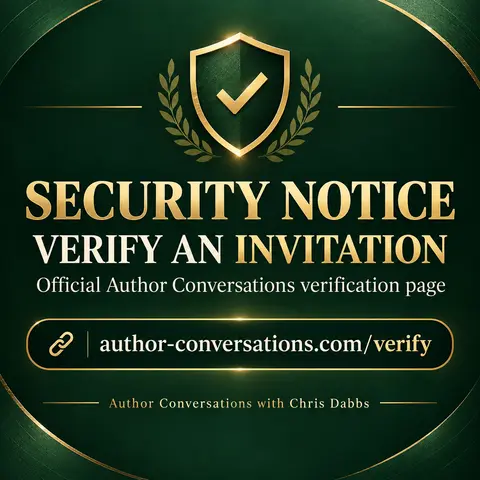
If you receive an unexpected invitation claiming to represent Author Conversations, particularly one requesting money, please verify it before responding.
Our official verification information is available here:
Verify an Author Conversations invitation
And remember, a genuine commercial service and a fraudulent approach are not the same thing.
You can disagree with the principle of paid interviews without suggesting that every professional producer offering them is a scammer.
Equally, the existence of legitimate paid services shouldn't prevent us from questioning whether some offers are misleading or exploitative.
Both points are worth making.
The Most Important Part of Any Interview? The Author
One of the great pleasures of presenting Author Conversations has been meeting people whose lives and experiences are completely different from my own.
Sometimes I finish an interview having learnt something unexpected.
Sometimes an author tells me a story that stays with me long afterwards.
And sometimes somebody who was initially nervous about appearing on camera finishes the conversation smiling and wondering why they were so worried.
Those moments matter.
I've never believed that a good interviewer needs to dominate a conversation.
Quite the opposite.
My job is to create the conditions in which somebody else can tell their story.
To listen, to ask questions and occasionally to recognise that the best thing I can do is say nothing at all.
That approach doesn't change according to whether an interview is commercially commissioned or independently selected.
The production arrangements may differ.
The editorial purpose may differ.
But the respect we show the person we're interviewing should remain exactly the same.
So, Should Authors Have to Pay for an Interview?
My answer is no.
Not as a general principle.
There should always be opportunities for interesting writers and worthwhile stories to receive independent editorial attention.
And that's one of the ambitions behind Author Conversations Weekly.
But should an author or publicist be able to commission a professional interview and production service if they believe it would be valuable to their publicity campaign?
Absolutely.
Just as they might commission photography, a promotional film, a website or other professional services.
The important thing is that they understand what they're purchasing and can make an informed decision about whether it represents value.
I don't expect everybody to agree with that approach.
The author whose email prompted this article certainly didn't.
I won't identify him, and I respect his right to disagree.
But his criticism raised a question that deserves an answer, and I'm glad we've had the opportunity to explore it.
Because ultimately, this isn't simply about whether somebody should charge £395 or £695 for a professional feature.
It's about the relationship between authors, publicity and journalism.
It's about transparency.
It's about trust.
And perhaps most importantly, it's about making sure that writers are treated fairly in an industry where getting noticed can sometimes feel almost as challenging as writing the book itself.
At Author Conversations, I want authors to feel comfortable, respected and confident that their story matters.
Whether they're commissioning a professional feature or joining us for a free editorial conversation, that principle remains the same.
The author should always be at the heart of Author Conversations.
About Chris Dabbs
Chris Dabbs is a British broadcast journalist, presenter and university lecturer, with experience including BBC radio, ITV News and Times Radio.
He presents Author Conversations with Chris Dabbs, a programme featuring in-depth interviews with authors, writers and thinkers from around the world.
Author Conversations offers professional commissioned interview services and is developing Author Conversations Weekly, a separate editorial programme exploring stories, ideas and experiences from the world of books.
Explore Author Conversations
Watch and listen to our interviews:
Explore Author Conversations episodes
Find out about our professional interview services:
Visit Author Conversations
Verify a genuine Author Conversations invitation:
Official verification page
Interested in the forthcoming New Authors feature?
We're developing free editorial opportunities for selected writers as part of Author Conversations Weekly. If you have an interesting story behind your book, we'd be pleased to hear about it through our official channels.