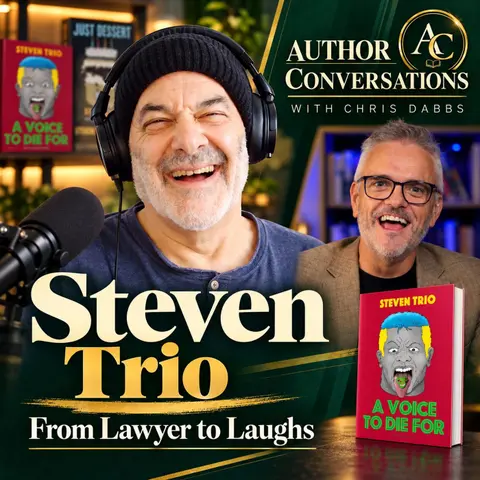
How Legal Training Feeds Comedy Writing: The Steven Trio Method
Discover how legal training and courtroom drama can become the ultimate breeding ground for absurdist humor and comedy writing. In this deep dive, we explore how author Steven Trio transitioned from an Old Bailey court clerk to writing punchlines, political satire, and comedy books destined for the big screen by channeling the ridiculous side of everyday litigation.
Key Takeaways
- Courtroom drama provides writers with raw, unfiltered human behavior and high-stakes tension that fictional narratives desperately need.
- The rigidity of traditional professions like law often forces creative individuals to overcompensate with absurdist humor and wordplay.
- Cross-examination techniques and witness interrogation mirror the timing and structure required for effective punchlines.
- Leaving a prestigious career in your twenties can unlock creative potential that standard educational paths systematically suppress.
- Translating real-life trauma or courtroom absurdity into satire offers a healthy psychological release and endless story material.
The Courtroom as a Comedy Incubator
To the average observer, a court of law is a place of solemn judgment, strict decorum, and severe consequence. But for a budding author with an eye for the absurd, the legal system is essentially a grand theater populated by eccentric characters taking themselves far too seriously. When Steven Trio stepped away from his brief stint as a qualified solicitor and found himself walking the halls of the Old Bailey, he wasn't just processing paperwork; he was inadvertently collecting a masterclass in human nature. The stark contrast between the heavy wigs, the towering oak benches, and the deeply flawed human beings standing in the dock creates an inherent irony that feeds straight into comedic fiction.
Comedy often relies on heightened tension followed by an unexpected release. Where is that tension higher than in a trial where a person's liberty hangs in the balance? Trio's experience witnessing actual criminal trials provided him with an unfiltered view of desperation, performance, and theatricality. While legal dramas usually lean entirely into grit and suspense, the observant humorist sees the underlying absurdity. People on trial are rarely the stoic villains of cinematic imagination; they are panicked, confused, and prone to bizarre rationalizations. Capturing these nuances allows a writer to craft fiction that feels grounded in real human error rather than cartoonish tropes.
Translating Cross-Examination to Punchlines
There is a surprising structural crossover between a sharp legal cross-examination and the delivery of a comedic punchline. Both require absolute precision, timing, and the deliberate withholding of information until the exact right moment. A barrister sets a trap with a series of seemingly innocuous questions, leading the witness down a specific path before pulling the rug out with an undeniable contradiction. A comedy writer does the exact same thing with a reader or an audience, establishing a premise, building a reasonable expectation, and then subverting it entirely.
Trio's background in preparing cases taught him how to look at an argument from multiple angles simultaneously. If a legal argument has a loophole, a clever mind will find it. That same mental agility is what makes for sharp satirical writing, such as his political farce The Jazzgate Scandal. Satire requires you to expose the systemic hypocrisy of institutions by pushing their logic just a fraction past its breaking point. Lawyers spend their days dissecting rules to see where they bend or snap; comedy writers do the exact same thing to social norms.
Breaking the Mold from Law to Laughter
The journey from a respectable, parent-approved profession into the unpredictable world of music and comedy is fraught with psychological friction. For Trio, the six months he spent working as a solicitor after years of grueling examinations represented a societal bargain—one he ultimately had to break to preserve his sanity. Many creative individuals find themselves funneled into traditional careers due to well-meaning familial pressure. Parents who survived economic hardship often view stability as the ultimate sanctuary, completely blind to the soul-crushing nature of a job that lacks personal resonance.
However, that detour into the legal profession was not a waste of time. It gave Trio the life experience he needed to write with authority. Without that brief exposure to corporate offices, legal jargon, and criminal courts, his satirical works would lack the authentic texture that sets them apart. True comedy needs a target, and you cannot effectively satirize an institution from the outside if you have never truly understood its inner workings. The exhaustion of wearing a suit to an office you despise provides a rich, bitter fuel for absurdist humor.
Finding Absurdist Freedom
Once Trio liberated himself from the legal world—dramatically tearing off his tie and running down Fleet Street—he leaned fully into his creative instincts. Influenced by legends like Spike Milligan, whose linguistic playfulness and surrealist sketches defied all conventional narrative logic, Trio began exploring poetry and comic verse. This evolution from jazz pianist to songwriter, and finally to author and screenwriter, proves that creative paths are rarely linear.
When you spend years bound by the rigid syntax of legal briefs, discovering the freedom of absurdist poetry is intoxicating. In legal writing, every single word must possess a precise, immutable definition to avoid contractual loopholes. In comedy writing, words are elastic toys meant to be stretched, twisted, and bent until they snap into something hilarious. The transition from defining laws to breaking linguistic rules is a natural rebellion for anyone who spent their youth trapped in a career built for someone else's expectations.
Conclusion and Further Reading
Steven Trio’s journey demonstrates that no life experience is ever truly wasted when it comes to creative writing. Whether you are drafting a binding contract or penning an absurd comedy sketch, understanding how people operate under pressure is the ultimate tool for a storyteller. To hear more about his incredible transition from the courtroom to the recording studio and his upcoming film adaptations, Listen to the full episode of Author Conversations with Chris Dabbs.